



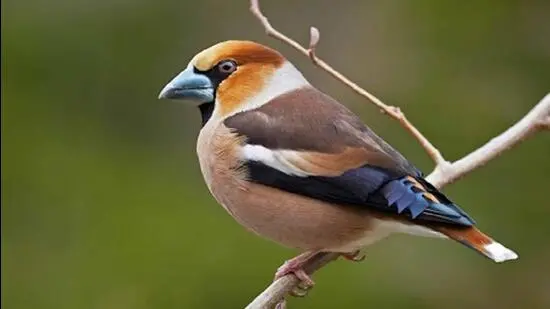
Haldwani: A Hawfinch bird, a species native to Europe, North Africa and East Asia, was recorded at Jim Corbett National Park in Uttarakhand.
The Hawfinch was photographed by Ramnagar-based wildlife photographer Prashant Kumar on November 23 during a safari in the Dhela tourism zone near Shikari Kuan.
Wildlife Institute of India (WII) scientist Suresh Kumar said this bird species is native to Europe and higher-latitude areas like Mongolia and Kazakhstan. “Sometimes during migration or wandering, such sightings are noted. It is called a vagrant bird sighting,” he added.
Ornithologist Sanjay Sondhi said this Hawfinch either got separated from its flock or got lost during its flight due to strong winds, but it is not native to India and there is no guarantee that it will be seen again.
Corbett Tiger Reserve director Saket Badola said the forest department has begun tracking the bird’s movement. “This species has been recorded only a few times in the Indian subcontinent. It typically moves in flocks, so this individual may have separated from its group during migration,” he said.
Forest teams have been deployed to ensure the bird’s safety, and the species has now been added to Corbett’s official bird records.
Prashant Kumar, who documented the sighting, said only two historical records of the Hawfinch exist in the Indian subcontinent, both from Pakistan-occupied Kashmir. “The species was reported from Muzaffarabad in 1908 and later from Aliabad in 2017,” he added.
The Hawfinch (Coccothraustes coccothraustes) is a robust, heavy-billed finch about 18 cm long, with a wingspan of 29–33 cm. Its powerful beak allows it to crack hard seeds, nuts and berries. Males and females look similar, though males tend to have slightly darker plumage.
Wildlife photographer Deep Rajwar said the species breeds across Europe and temperate Asia. “Many northern populations migrate south in winter, which may explain its recent presence in Corbett. Globally, the bird is considered rare and is only occasionally reported from remote migratory routes, including sightings as far as western Alaska,” he said.
Officials said the sighting has generated excitement among ornithologists, researchers and birdwatchers across the region.