



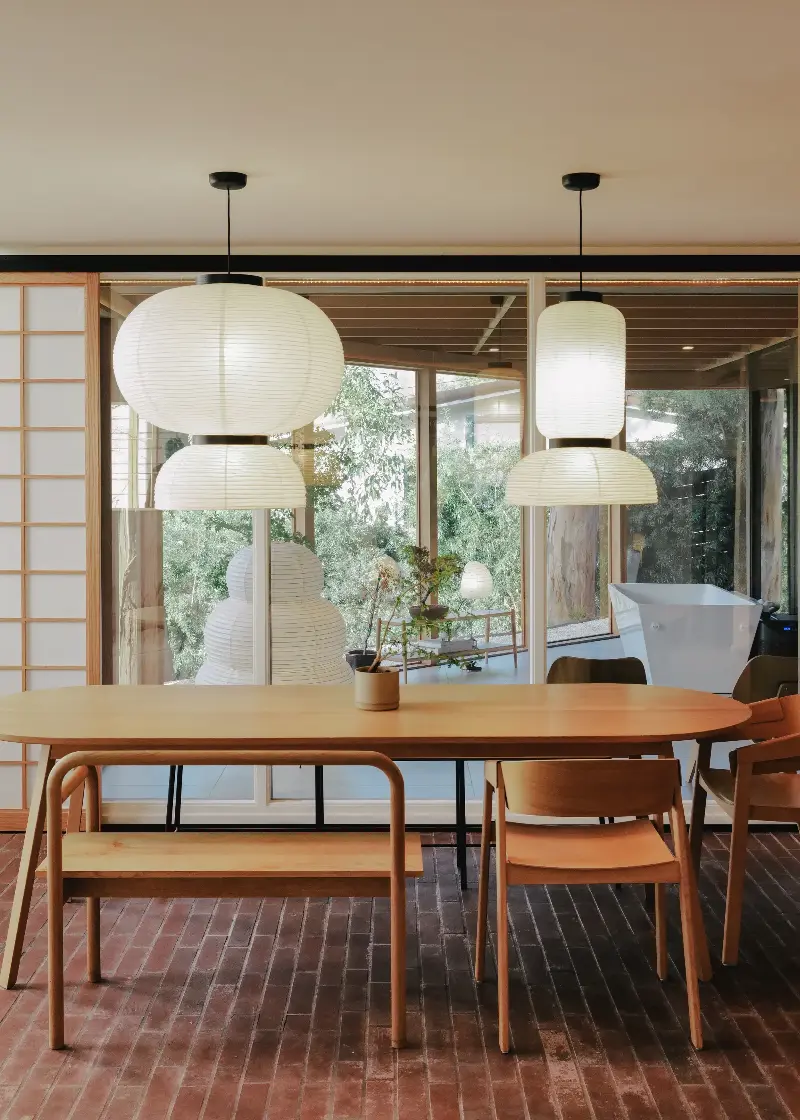
Fukensei, translating to asymmetry or irregularity, is a notable theme in Japanese homes. And in 2026, with less performative, more lived-in spaces being the talk of the moment, it's an artful way to return visual interest to your home.
Rather than setting your life against overly perfected, comprehensively symmetrical rooms, fukinsei is a Japanese design principle that encourages you to experiment with subtle irregularities.
Think of it this way: if some of your living spaces are currently a mirror image when split down the middle, fukinsei will make it so that your design story is not so predictable. And here's how.
What Is Fukinsei?
"Fukinsei (不均整) is the Japanese aesthetic principle of asymmetry, rooted in Zen Buddhism," explains interior designer Yoko Kloeden. "In Zen thinking, symmetry and perfection imply completion — and completion implies an ending."
Yoko explains that something perfectly balanced has nowhere left to go. "Asymmetry, by contrast, suggests movement, growth, and the possibility of change," she adds.
"There is a phrase for this: the beauty of avoiding completion," Yoko continues. "What is perfectly ordered is, in a sense, static or close to death. What is deliberately uneven remains alive."
As a tenet of the Japanese concept of wabi-sabi, fukinsei has genuinely taken my apartment from simple to subtly striking. But how does it actually impact a space?
How Does Fukinsei Impact the Layout of a Room?
Symmetry is one of the most outdated interior design rules, and Japanese spatial planning has been ahead of the curve for a long time now. To better understand the impact of fukinsei in a typical Japanese home, Yoko draws attention to the tea room as the clearest example.
"In a chashitsu, duplication and symmetry are consciously avoided," she shares. "If there are fresh flowers, a painting of flowers is not permitted. If a round kettle is used, the water vessel must be angular."
"Even when a vase is placed in the tokonoma (alcove), it is never centered," Yoko adds, "purely because that would divide the space into two dead halves. Even the alcove's timber column is chosen from a different species than the room's other pillars, to break monotony."
She explains that every element is in tension with the others. "Not to the point of chaos, but in a way that feels dynamically balanced," she notes. "The tea room finds beauty in this fluid, indeterminate quality by introducing a composed incompleteness that keeps the eye gently engaged."
How to Bring Fukinsei into Your Interior Design
"Fukinsei is not randomness; it is considered imbalance," says Yoko. "In ikebana, stems are never arranged symmetrically; the composition relies on tension between mass and negative space."
"In bonsai and Japanese garden design, branches and rocks are placed to appear natural, which means deliberately avoiding regularity," she continues. "In traditional architecture, buildings within a temple complex are staggered rather than aligned on a central axis."
For a contemporary home, Yoko finds that fukinsei translates well into its layout. "A sofa placed off-center with a single armchair at an angle, rather than a matching pair flanking a fireplace, creates a room that feels more alive," she says. "Choose materials with individual character — a hand-thrown ceramic, an irregularly grained timber — over machine-perfect uniformity."
"When composing objects on a shelf, work in odd numbers and vary heights, leaving breathing space rather than filling every surface," she adds. "The goal is not imperfection for its own sake, but a quality of openness: spaces that feel composed yet unfinished, settled yet still becoming."
FAQs
Is Fukinsei the Same as Wabi-Sabi?
Fukinsei isn't the same as wabi-sabi; however, it is one of the design principles that uphold it. Since wabi-sabi is about embracing the beauty in imperfection, fukinsei ties into this master principle by shining a spotlight on asymmetry.
Why Do Designers Avoid Perfect Symmetry?
Interior designers avoid decorating a space to showcase perfect symmetry for one key reason — it doesn't look real. Not everything stays in equilibrium all the time, including homes. So using subtle asymmetry can give the eye some interest to look forward to.
If you want to see the difference these Japanese principles of design can make to a home, tour this Glass Ridge House in Los Angeles.