



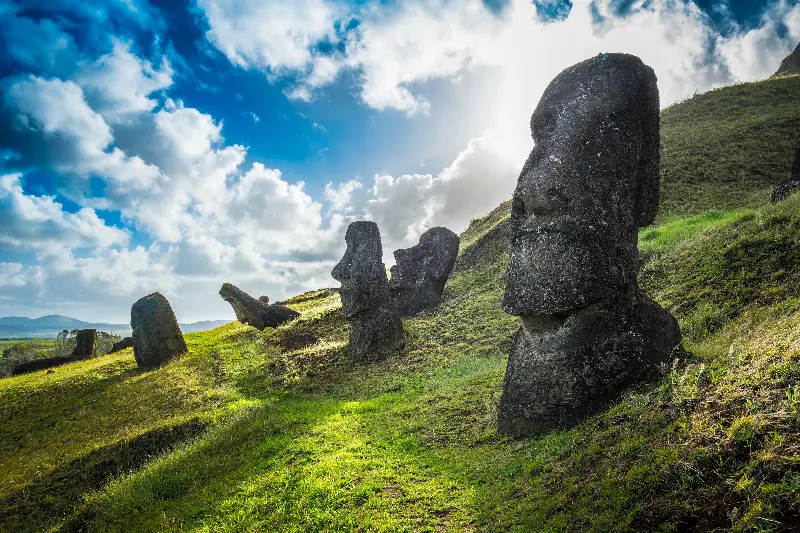
Despite standing on one of the most remote inhabited places on Earth, the iconic moai of Easter Island (Rapa Nui) can now be experienced from the comfort of your home.
This is thanks to a new, interactive reconstruction of Rano Raraku, the crater from which most of the giant statues were quarried, which allows people to get virtually up close to the island’s famous moai.
The model has been created by an international team of researchers, led from the State University of New York at Binghamton, who used drones to capture a whopping 22,000 photos of the quarry which were then painstakingly stitched together into a 3D model.
“As an archaeologist, the quarry is like the archeological Disneyland,” said paper author and Binghamton University professor Carl Lipo.
“It has everything you can possibly imagine about moai construction, because that’s where they did most of their construction.
“It’s always been this treasure of information and cultural heritage, but it’s remarkably underdocumented.”
The creation of the model was requested by a community group on Rapa Nui in the wake of a wildfire that swept through Rano Raraku back in October 2023.
The local group wanted to ensure that the quarry was comprehensively documented, lest it ever be permanently damaged in the future.
The moai—which were carved by the Rapa Nui people out of a type of solidified volcanic ash known as “tuff”—have been dated back to between A.D. 1250 and 1500.
The largest statue, “Paro,” stands at 33 feet tall and is estimated to weigh around 82 tonnes. Each is a whole-body statue (although many of the moai are buried up to their shoulders), but with an exaggerated head, reflecting Polynesian beliefs of the sanctity of the head and how such is the seat of an individual’s spiritual energy.
It has been estimated that as many as 1,000 of the statues were originally created, although fewer than 900 exist today. Around 400 remain in the Rano Raraku quarry, with the rest transported to stand around the perimeter of the island on stone platforms called ahu.
The new model not only lets viewers take a close look at the moai still in Rano Raraku, but also to zoom out and pan around various features of the quarry, which is located in a volcanic crater too steep and rugged to safely traverse.
“You can see things that you couldn’t actually see on the ground,” explained Lipo. “You can see tops and sides and all kinds of areas that you just would never be able to walk to.”
Alongside allowing everyone to experience exploring Rano Raraku, the new model also affords researchers a 3D model that they can use as an academic resource.
“We can say, ‘Here, go look at it’ if you want to see the different kinds of carving, fly around and see stuff there,” Lipo said.
“We’re documenting something that really has needed to be documented, but in a way that’s really comprehensive and shareable.”
The team are keen to stress, however, that the model is no substitute for the real thing.
“People on the island are afraid that if we build three-dimensional models that no one will go to the island,” said Lipo.
“But I think this will actually inspire people to go there…This is an incredible landscape of stuff that you could really go visit, that you’ll want to go see.”
Back in virtual reality, the researchers have already used the new 3D model to examine the sites of 30 different workshops across Rano Raraku.
The pattern of the quarrying—and the use of different techniques from site to site—adds to previous evidence suggesting that the island was occupied by a number of independent groups working on carving the moai independently, rather than the collective effort being overseen by a centralized chiefdom.
“We see separate workshops that really align to different clan groups that are working intensively in their specific areas,” explained Lipo.
“You can really see graphically from the construction that there’s a series of statues being made here, another series of statues here, and that they’re lined up next to each other.
“It’s different workshops,” he concluded.
The 3D model of Rano Raraku can be explored online.
Do you have a tip on a science story that Newsweek should be covering? Do you have a question about the moai of Easter Island? Let us know via [email protected].
Reference
Lipo, C. P., Hunt, T. L., Pakarati, G., Pingel, T., Simmons, N., Heard, K., Shipley, L., Keller, C., & Omilanowski, P. (2025). Megalithic statue (moai) production on Rapa Nui (Easter Island, Chile). PLOS ONE, 20 (11). https://doi.org/10.1371/journal.pone.0336251