



Dear Alex,
My daughter recently passed her manual driving test which was a requirement to join Thames Valley Police. Her budget is up to £3,000. Could you advise on the most reliable, safe and cheap-to-insure first car?
– MA
Dear MA,
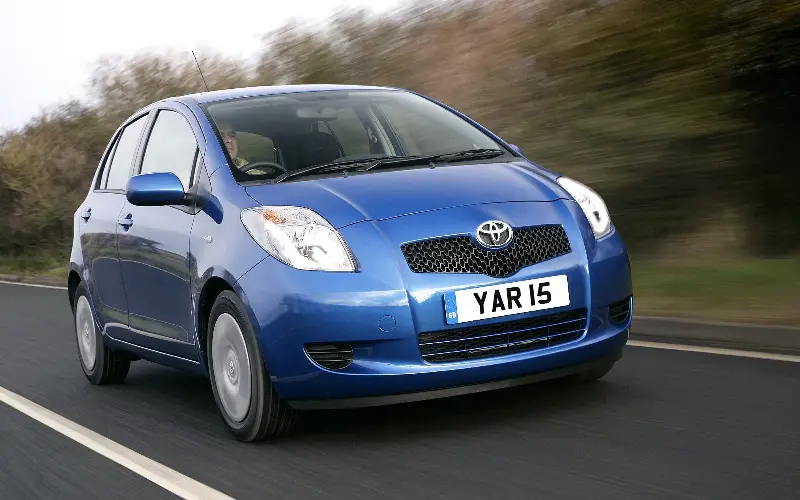
The best fit is a Toyota Yaris. Like most Toyotas, they tend to be very durable if treated well; a Yaris with a full service history should last and last.
A 1.0-litre version of the second-generation Yaris (2005-2011) has a Group 2 insurance rating, which is almost as cheap as it gets. It’s also has a full five-star rating from Euro NCAP when it was crash-tested, with a sterling score of 35 out of 36 for adult occupant protection. While it wouldn’t score as highly under today’s more stringent test regime, in the context of its contemporary rivals that’s impressive.
This version has an official average fuel economy of 55mpg and will cost £35 a year to tax. I found a 2010 Yaris 1.0 T2 with only 51,000 miles and a full service history for £2,950.
Other options? The closely related Hyundai i20 and Kia Rio don’t have quite such a strong reputation for dependability as the Toyota, they still last well. With simple mechanicals and cheap parts, they tend to be cost-effective to maintain.
Both have five-star Euro NCAP safety scores and cost £35 a year to tax in 1.2-litre form. Both should achieve slightly better fuel economy than the Yaris, too, though not by much. The Hyundai is in Insurance Group 5. The Kia is in Group 4. I found a smart-looking 2012 Rio 1.25 1 with 80,000 miles and a full history for £2,695.
A Ford Fiesta is the perennial first car choice for a reason – it’s easy to drive and cheap to fix. While it doesn’t have the same strong record for reliability as the other cars here, a well-maintained example will be an affordable way of getting around.
For the lowest insurance, look for a Style or Studio version with the 1.25-litre engine, both of which should achieve 52mpg. I found a 2012 1.25 Studio with 92,000 miles and a full history for a bargain £2,595.
Why does our friend’s diesel engine cut out and then restart?
My friend’s 2009 Peugeot 207 diesel runs fine, but will stall occasionally, accompanied by the message “Pollution Control Failure”. It will fail to start for a minute or so, then fire and continue without issue. There’s no pattern – it happens summer or winter, long or short trip, engine cold or hot. The problem has made her wary of using smart motorways, which lack a hard shoulder. Various garages have failed to cure this problem. Do you have any ideas?
– MB
Dear MB,
The presence of the anti-pollution warning made me wonder whether this was a diesel particulate filter (DPF) issue, which is usually what “anti-pollution” refers to in most cars. However, it’s unusual for a clogged DPF to cause the engine to stop, what’s more, such a failure would normally not clear itself with a restart.
It’s useful to know, however, that on Peugeots of this era, a “pollution control failure” warning can be caused by any number of faults with the fuel or pollution control systems, or both. The engine’s electronic control unit (ECU) detects an anomalous reading and brings up the display. Because of this, the pollution control warning can sometimes be a bit of a red herring.
There should be a fault code stored within the ECU, but were this the case it should have been picked up easily with the correct reader. The garages in question may not have been able to read the ECU with their equipment, or they may not even have tried (although this seems unlikely).
If that’s the case, you might find that paying for the diagnostic fee at a Peugeot main dealer is worth the money, as they will have the right equipment to read the fault codes. That might provide a plausible diagnosis to present to her local garage, which can repair the car at more affordable labour rates than the main dealer.
Your query dredged up a memory that a batch of 207s was recalled in 2008 to have their fuseboxes replaced. Yours was made too late to be part of this recall, but I’ve heard of later cars failing with the exact symptoms you describe and being remedied with the fitment of a new fusebox, so it’s not a bad idea to have it checked.
Other potential issues could include low fuel pressure caused by a faulty fuel pressure regulator or fuel pump, or a problem with the exhaust gas recirculation valve.
These could throw up a pollution control warning and in extreme cases could cause the car to stall, as the ECU could be detecting the fault and shutting down the engine to protect it. If the fault clears the next time the engine is started, the car would then drive as normal – just as you describe.
Do you have a question? Contact [email protected]