



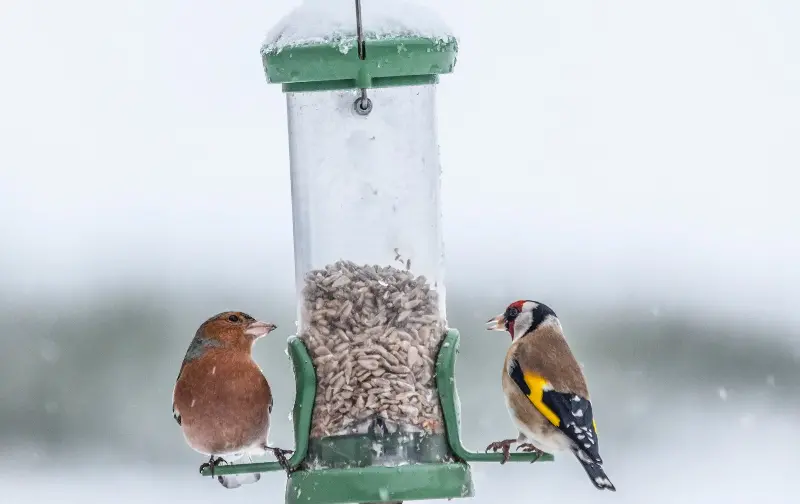
What a quandary! Most of us get huge pleasure from watching hungry garden birds feasting on the treats we have hung up for them. We are helping the wildlife and watching all the various and fascinating interactions that go on in the process, and our gardens become huge, lively hubs for our feathered friends.
But are we doing more harm to them than good? We do not know for sure yet, but the leading bird charities are currently conducting in-depth research into the subject, with an aim of announcing their findings next spring.
A primary concern is the spreading of disease, most notably trichomonosis. This is found in many birds, including pigeons and birds of prey, but is most well-known for its disastrous effects on greenfinch populations due to an epidemic in 2005. Earlier this year the RSPB withdrew the sale of flat bird feeders as they are thought to spread the disease. As Dr Kate Plummer from the British Trust for Ornithology (BTO) explained: “Birds become sick and the disease spreads through their saliva; infected birds cannot swallow and then regurgitate the food back out, probably onto the table.”
Anyone who feeds birds will have noticed that the main visitors benefiting are usually the blue tits and great tits. The numbers of these massively increase, in line with our supplementary feeding, and populations of other species of birds are thought possibly to decline as a result.
The danger zone
One thing that most experts agree on is that if you see a sick bird potentially suffering from the dreaded trichomonosis, you should stop feeding immediately and withdraw your feeders. It’s counterintuitive, but a bird that looks lethargic and feeble with its eyes half closed may well have this nasty disease, and so by feeding it you are encouraging the spread of the disease.
Another thing that most influential bodies agree on is that if you do feed the birds you should wash the feeders weekly with soap and water, and maybe mild bleach. Water left out for birds should be changed daily. Flat bird feeders are definitely discouraged as they increase the risk of transmission.
Another problem many have with flat tables and other bird feeders is that they attract rats, pigeons, magpies and grey squirrels. Feeding birds on the ground makes many birds such as blackbirds more vulnerable to cats and other predators. Bird feeders also provide a buffet for sparrow hawks, who will hang around to pick off a songbird for supper.
How to provide food for birds safely
I checked out the views of the well-respected environmental campaigner Chris Baines. He surprised me when he explained why he too had stopped feeding the birds in his famous suburban wildlife garden on the outskirts of Wolverhampton. He has designed his garden with the maximum pulling power for a wide range of wildlife. There are nest boxes, thick evergreen hedges (for shelter and enclosure), a big pool (water is vital), a wide range of native species and a not-too-tidy approach to dead wood and other rotting elements that pull in the beetles, fungi and other insects.
Chris noticed that the main users of his bird feeders were the blue tits and great tits, while other species did not get much of a look-in. He also pointed out that if he went away, their food source went too. So, on balance, he thinks withdrawing the supplementary feeding is definitely a better approach for his garden. As he put it, “Bird feeders have made a great contribution to conservation, particularly as the range of foods has become ever more sophisticated. I enjoyed attracting birds to feeders for decades, but when ‘my’ greenfinches, siskins and other communal feeders began to disappear, I chose to stop.” Now he relies on his thoughtful garden management system to sustain them.
Find a strategy to suit your garden
In our household, my husband loves feeding the birds, and we have fairly animated discussions about it. I chatted to Jon Carter, who works for The British Trust for Ornithologists, to help us decide whether we should feed the birds or not. Jon highlighted the fact that if you have a garden in an urban environment with more paving than plants, then if you do feed the birds, you probably are helping their numbers – especially populations of birds such as house sparrows, which have been in decline for decades.
Artificial feeding has most likely really helped to keep them going. They love millet and the smaller seeds. If, on the other hand, you have a garden in the country, which has a good range of habitats designed for wildlife, then unless the temperatures drop to 4C or lower, it probably is not necessary, and in fact better not to provide supplementary food.
If you are putting up feeders, as well as cleaning them weekly, it is good to move the feeders around so that you don’t get mouldy food building up on the ground nearby. Undoubtedly, we are massively inflating certain bird populations as we are putting out about half the amount of food needed for the entire bird population in the countryside (according to 2019 figures). The amount spent on wild bird food is considerable – around £380m (in 2023). If the relevant research shows that we are doing more harm than good, then it is not only the great tits who will be a bit peeved.
See Bunny’s YouTube videos: