



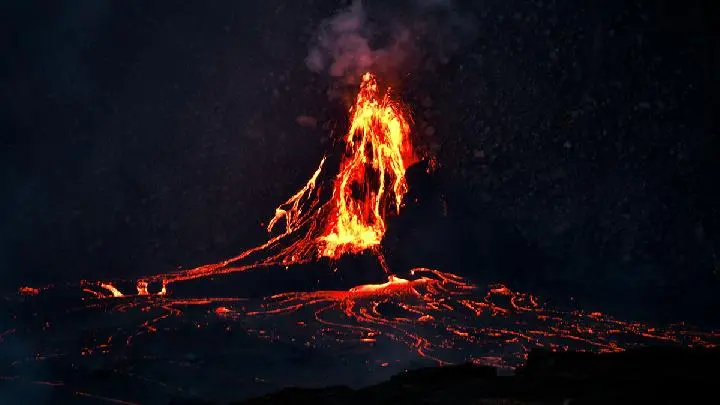
TEMPO.CO, Jakarta - The eruption of the Hayli Gubbi volcano in the northern Afar region of Ethiopia on Sunday morning, November 23, 2025, ended its 12,000-year-long dormancy. The eruption sent plumes of ash across the Red Sea, reaching Yemen, Oman, India, and northern Pakistan.
The volcano, located about 500 miles northeast of Addis Ababa, erupted for several hours. The eruption blanketed the nearby village of Afdera in ash. The Toulouse Volcanic Ash Advisory Center (VAAC) in France recorded the ash column reaching a height of about 14 kilometers.
"[The eruption] felt like a sudden bomb had been thrown," said Ahmed Abdela, a resident of Afar, quoted from Al Jazeera, on Monday, November 24, 2025. Many tourists heading to the Danakil Desert were stranded in ash-covered Afdera.
Local administrator, Mohammed Seid, confirmed that there have been no human or livestock casualties so far. However, the eruption could potentially disrupt the economic conditions of the local herding community. "Many villages have been covered in ash, and as a result, their animals have little to eat," he said.
The 500-meter-tall volcano sits in the Rift Valley, a zone where two tectonic plates meet, known for its intense geological activity. The Smithsonian Institution's Global Volcanism Program reports that Hayli Gubbi has no record of eruptions during the Holocene, the geological era that began about 12,000 years ago.
How Could the Long-Dormant Ethiopian Volcano Erupt?
According to Scientific American, researchers considered this eruption to be unusual, as Hayli Gubbi is a known shield volcano. These volcanoes generally oozes lava flows instead of "expelling giant columns of ash."
Juliet Biggs, an earth scientist from the University of Bristol, said such an eruption in this area is highly unusual. "To see a big eruption column, like a big umbrella cloud, is really rare in this area,” said Biggs.
Scientists attribute the activity to the geological conditions in the East African Rift Zone, where the African and Arabian tectonic plates are moving apart by about 0.4 to 0.6 inches per year. This process causes the Earth's crust to thin and hot rocks to rise up from the mantle, allowing volcanoes to erupt even if they have been inactive for a long time.
"So long as there are still the conditions for magma to form, a volcano can still have an eruption even if it hasn’t had one in 1,000 years, 10,000 years," said Arianna Soldati, a volcanologist from North Carolina State University.
Previous researchers had also noted signs of activity before the eruption, including magma intrusion from the Erta Ale volcano being pushed more than 18 miles below the surface to the Hayli Gubbi area. They also detected a rise in the ground's surface by a few centimeters, as well as the appearance of a white cloud at the summit.
After the eruption, a scientist from the University of Southampton, Derek Keir, collected ash samples to determine the magma's characteristics and to confirm whether or not Hayli Gubbi had truly been inactive for 12,000 years. Biggs stated that this event emphasizes the lack of in-depth knowledge about the volcano. "It really just shows how understudied this region is," she said.