



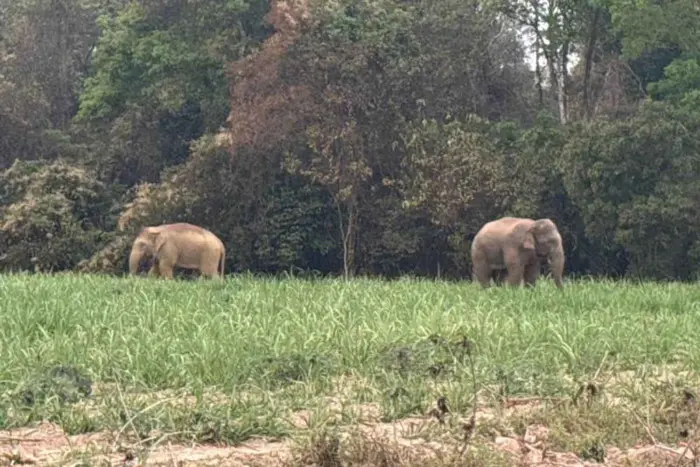
The death of a 20-year-old wild elephant during relocation in Loei has intensified scrutiny of the government's handling of escalating human-elephant conflict in the Northeast.
Seedor Hu Pub died during a translocation operation intended to return it to its original habitat in the Phu Luang Wildlife Sanctuary. The incident has prompted public concern over wildlife protection and exposed mounting tensions between rural communities and roaming herds. The relocation followed a ruling by the Khon Kaen Administrative Court last November ordering the Department of National Parks, Wildlife and Plant Conservation to remove four aggressive wild elephants, including Seedor Hu Pub, from farmland in Khon Kaen's Phu Wiang district.
Locals had petitioned the court, citing fatalities among family members and severe crop losses blamed on elephant incursions. In compliance with the order, officials began moving the animals. The operation ended in tragedy with Seedor Hu Pub's death, after which the department suspended all elephant translocations nationwide. Conservation officials warn that the Northeast, particularly the Phu Khieo–Nam Nao Forest Complex, which includes Phu Luang, risks becoming the country's second major conflict hotspot after the Eastern Forest Complex.
Sukhee Boonsang, director of the Office of Wildlife Conservation, said inaction would deepen the crisis. "If we have done nothing, it will repeat the severe situation in the eastern forest complex. We have found it more difficult to manage the wild jumbo that often stays outside the forest zone. They have preferred to stay in the agricultural zone due to plenty of food," he said.
Figures show 638 wild elephants inhabit the Phu Khieo–Nam Nao forest complex. Last year alone, officials recorded 828 instances of elephants straying beyond forest boundaries, resulting in four injuries and six deaths. Since the start of this year, five people have been injured and four killed.
The department paid 37.24 million baht in compensation between last April and this February to 706 affected households, covering loss of life, crop damage, and property destruction. Annual compensation spending exceeds 100 million baht, drawn from the central budget, although officials acknowledge that payouts do not address root causes.
Elephant populations are expanding. The average annual growth rate stands at around 3%, rising to 8.2% in the eastern forest complex, where conflict is most acute. Nationally, 4,629 wild elephants live across 16 forest complexes and 91 conservation areas, with 71 zones experiencing some level of confrontation, he said. Casualties have risen sharply over two decades. In 2001, authorities recorded one injured person and three deaths. By 2017, the figures had climbed to 25 injuries and 19 deaths. Last year saw 29 injuries and 30 fatalities. So far this year, 19 people have been injured and nine killed.
Officials are pursuing multiple strategies, including increasing natural food sources within forests, curbing encroachment and strengthening community patrols. More than 191 monitoring teams operate nationwide, supported by 227 local networks receiving 50,000 baht each to help prevent elephant intrusions.
A fertility control trial using a SpayVac vaccine has also begun, he said. Administered to female elephants, the injection prevents pregnancy for up to seven years without known health side effects. After successful trials in African elephants, three animals in the eastern forest complex received the vaccine in January, with plans to expand to 15 more.
"The confrontation is expected to escalate due to increasing population and shrinking forest zones," Mr Sukhee warned. "We have seen an increasing number of elephants in Phanom Dong Rak-Pha Tam Forest Complex (in the northeastern region), some of which cross the border from Laos. The department has been studying the possibility of having a large-scale plot of land for a new home for elephants."