



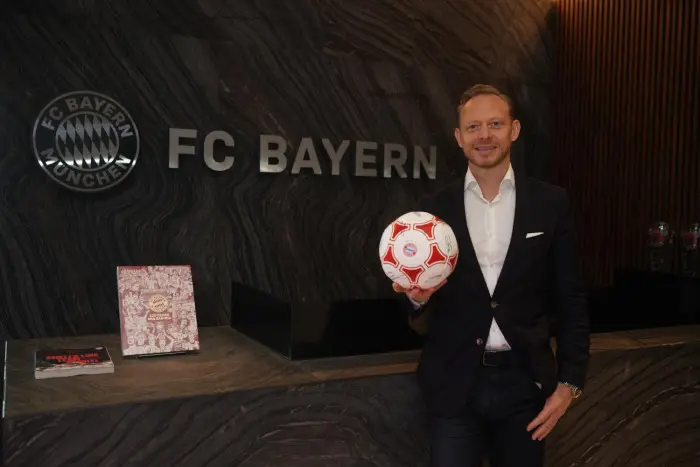
When Bayern Munich opened their Bangkok office in 2022, it marked the German champions' third overseas base after New York and Shanghai. For Rauven Kasper, the club's board member for marketing and sales, the decision was not about following rivals into familiar hubs such as Singapore or Hong Kong, but about embedding themselves in a market where football culture is lived on the streets.
Kasper, who oversaw Bayern's Asia‑Pacific strategy, recalls weighing up options five years ago.
"Other clubs chose Hong Kong or Singapore, but Bayern is different. We wanted to be closer to the people, to bring the experience directly into their lives. That's why Bangkok became our home in Southeast Asia," Kasper told the Bangkok Post in an exclusive interview recently.
The office's mission is threefold.
First, to localise Bayern's brand and connect with fans through media, social platforms and events. Initiatives such as the "Bayern Run" for Thailand's running community illustrate how the club seeks to blend sport with lifestyle. Merchandise is another pillar, with Kasper keen to ensure supporters can access official products, including special Thai collections developed with local partners.
Second, the club is building sustainable commercial ties. German companies already active in Thailand are being linked with Bayern's presence, while Thai firms are invited to collaborate. "It's about strong relationships," Kasper explains. "Not just selling shirts, but creating meaningful partnerships."
Third, and perhaps most significant, is youth development. Bayern are working with local governments and private academies to nurture talent.
The pathway is clear: grassroots to academy, then potentially to Germany. Kasper points to Maycon Cardozo, discovered in Bangkok and now progressing through Bayern's youth ranks, even making appearances for the first team.
"We want to give Thai players opportunities, and in turn strengthen the Thai national team," he says.
Unlike representative offices that operate at arm's length, Bayern's Bangkok base is a fully fledged legal entity, paying Thai taxes and employing staff directly contracted to the club.
"It's a commitment," Kasper stresses. "We don't just fly in and out. We listen, learn and create together with the local market."
For Kasper, the ultimate motivation remains simple: bringing happiness.
"Football is about experience," he says. "Our currency is joy. That's what we want to deliver."
He admits one frustration: Bayern haven't played in Thailand for many years. And this year's summer tour will take them to Asia, but not Bangkok.
"It's hard to find the right partner to host us," he concedes. "But I am very sure that within the next one or two years we will bring our stars -- Harry Kane, Manuel Neuer, Joshua Kimmich, Jamal Musiala -- to Thailand. That is my strong motivation."
Youth development across Asia is accelerating, Kasper notes, with Japan and South Korea leading the way. Thailand, he believes, is catching up fast thanks to improved infrastructure and academies. Two more Thai youngsters have recently joined Bayern's training programmes, underlining the club's commitment to scouting and nurturing regional talent.
For Bayern, Bangkok is not just a commercial outpost. It is a bridge between Europe's most decorated club and a passionate fan base in Asean. As Kasper puts it: "We are founded by the people, and we are here for the people."