



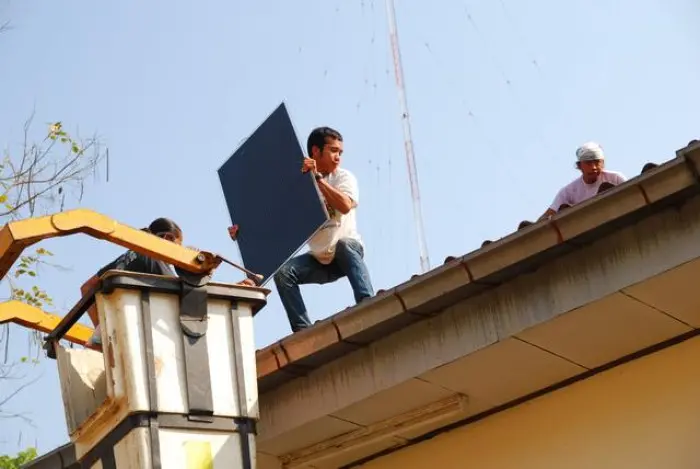
Solar power is Thailand's master key in the fight against global warming. It is cheap, popular, and even promoted by the state. But beneath the success story lies a big question: What happens when millions of panels begin to die?
Needless to say, without proper measures, Thailand's clean energy rush risks dumping a toxic legacy for the next generation.
Under pressure from climate change, the government has accelerated its push towards reducing greenhouse gas emissions and achieving carbon neutrality. Solar energy sits at the centre of this strategy. With falling costs and policy support, installed capacity has grown at remarkable speed -- from just 2.5 megawatts two decades ago to nearly 5,000 megawatts today -- and continues to expand across all sectors.
The latest tax incentives for rooftop solar reinforce this momentum, signalling another push into the clean energy era.
The problem is that the policy conversation still stops at how to get more solar panels installed at factories and homes. What comes after -- the full life cycle of solar panels -- remains largely unplanned.
Policymakers must look beyond installation, or Thailand's clean energy dream will eventually make the country drown in a sea of toxic waste.
For solar to be genuinely clean and sustainable, the country must look beyond how many panels are installed. It must pay equal attention to what happens when those panels reach the end of their lifetime.
Promoting mass adoption without a clear system for managing old panels may help tackle climate change in the short term. In the long term, it creates a new environmental problem -- one that future generations will be forced to clean up.
Most solar panels last around 25 to 30 years before efficiency drops, and they must be removed. Under current installation trends, Thailand's solar waste will continue to rise steadily.
By 2030, cumulative discarded panels could reach around 9,900–57,200 tonnes. By 2032, this will increase to 17,900–78,100 tonnes. By 2050, the figure is expected to surge to between 431,000 and 728,000 tonnes.
The annual burden is no less alarming. Because of the installation boom between 2010 and 2020, Thailand is likely to face 18,700–28,900 tonnes of solar waste per year by 2040. A decade later, this could rise to 44,600–66,200 tonnes annually.
Alongside the sheer volume, there is the problem of what these panels contain. By 2040, accumulated solar waste is expected to hold significant amounts of heavy metals, including 3.0–17.2 tonnes of lead and 6.9–40.0 tonnes of antimony. Without a clear and effective management system, these substances pose real risks to both the environment and public health.
Yet Thailand still lacks a clear framework for end-of-life solar management. Existing guidelines focus on landfill, incineration, or exporting waste abroad. These options are risky, environmentally harmful and offer little protection against toxic leakage.
At present, Thailand has no clear system for managing end-of-life solar panels. There are only guidelines from the Energy Regulatory Commission that are limited to landfill, incineration, or exporting waste for treatment abroad. These options carry high risks of pollution from heavy metal leakage, especially lead and antimony.
The problem is not only ecological. It has an economic cost. Uncertainty over solar waste disposal has become an investment risk. The Clean, Affordable, and Secure Energy for Southeast Asia (CASE) Thailand Report for 2024 warns that the lack of a clear policy framework on disposal forces solar rooftop projects to add a "risk premium" of around 0.5–0.6% to cover future waste management costs. The big question is who will bear the cost and which party will bear the cost and responsibility.
There is also an unseen loss of opportunity. Without recycling, Thailand is throwing away valuable resources. Discarded panels contain copper and silver worth hundreds of millions -- and potentially billions -- of baht. By 2040, the value of materials lost in solar waste could range from 281 million to 3.7 billion baht.
The climate cost is just as troubling. Studies show that failing to recycle solar panels almost doubles the carbon footprint of solar electricity itself. In other words, a technology meant to cut emissions ends up carrying a much heavier climate burden than it should.
So what can Thailand do? The problem is not a lack of technology. It is a lack of policy.
First, responsibility must be clearly defined for producers and polluters. Laws based on Extended Producer Responsibility or the Polluter Pays Principle should spell out who pays for what -- from collecting old panels for reuse, recycling, and final disposal. Without clear rules, everyone benefits from solar, but no one takes responsibility for its waste.
Second, Thailand needs to have a reliable state monitoring system to locate the waste. A national tracking system should record every panel from import to decommissioning. Without a central registry, planning is guesswork and accountability is impossible.
Third, dead panels should not all be treated as total rubbish. Many can still be reused. Proper collection and sorting systems would keep usable panels in circulation and reduce the volume sent for recycling.
Fourth, recycling itself needs proper rules and safeguards. Domestic plants require clear environmental, technological, and safety standards, backed by certification and incentives to invest in better recovery technologies.
Finally, Thailand must invest in the long game. That means supporting research and development in new recycling technologies, designing panels that are easier to dismantle, and building the industries needed to manage solar waste over decades, not just the next few years. Needless to say, policy must support solar panels that are made and designed with good waste management.
Only then can solar power be considered truly clean -- not just when it is switched on, but when it is finally switched off. This would also open new opportunities for Thailand to build a recycling and circular economy. Both are vital to the energy transition and carbon neutrality.
Whether Thailand gets there depends on decisions made now. The energy transition will be judged not only by how much clean power it produces but also by how responsibly it deals with the waste it leaves behind.
Nattaphorn Buayam, PhD, is a research fellow at the Thailand Development and Research Institute (TDRI). Policy analyses from the TDRI appear in the 'Bangkok Post' on alternate Wednesdays.