


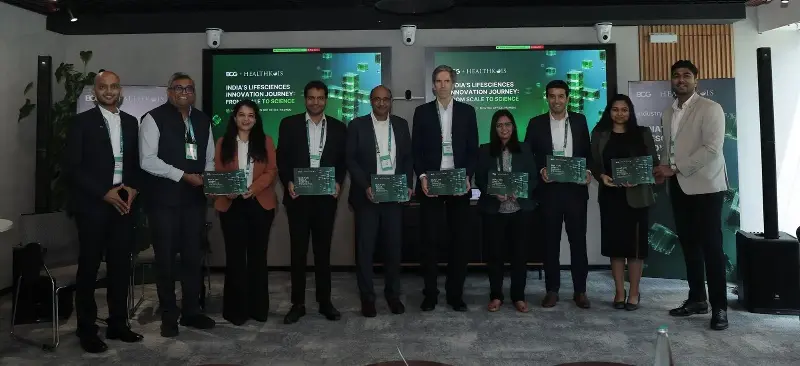
India, July 15 -- BCG and HealthKois has released a joint report, 'Built on Scale, Turning to Science: India's Pharma and Life Sciences Innovation Opportunity' that maps the momentum in drug discovery, advanced therapeutics and AI, alongside the structural gaps in capital, clinical trials and R&D that India must close to build a globally competitive innovation engine.
Drawing on 30+ in-depth interviews with founders, pharmaceutical executives, investors and ecosystem leaders across India and global markets, together with analysis of patents, venture investments, innovation pipelines and global datasets, the report finds measurable progress across novel drug assets, advanced therapies, AI-enabled discovery and platform technologies.
Green shoots of innovation are emerging, and momentum is building. India has produced more than 10 novel drug assets over the past decade. PE/VC investment into pharma rose 2.1x in five years to $731 million in FY26, and biotech startups grew from roughly 1,500 to 2,400.
The innovation pipeline expanded approximately 1.5x to more than 1,095 drug discovery programmes across 195 companies, while pharma patent families originating from India climbed from roughly 716 in 2015 to 2,995 in 2024, lifting India's share of global pharma patents from 3-4% to about 10%.
Four enablers are converging to support India-origin innovation: around $5 billion of government funding for early-stage and translational research; a strengthening role for academia through industry partnerships and technology-transfer offices; regulatory reform that has compressed drug-development timelines from 180-270 days to 60-120; and shared R&D and manufacturing infrastructure such as Genome Valley and C-CAMP. Early proof points of lab-to-market translation are already visible - including BIRSA 101, India's first indigenously developed CRISPR-based therapeutic, and NexCAR19, priced at roughly one-tenth of comparable overseas CAR-T therapies
Companies are pursuing multiple pathways to compete globally. Small molecules account for about 49% of PE/VC investment and 58% of active patents, while AI and digital therapeutics attract around 17% of private capital. Landmark deals signal growing international confidence in India-origin science, including Glenmark's $700 million upfront licensing agreement with AbbVie (with up to $1.2 billion in milestone payments), partnerships with Almirall and Astria Therapeutics, ImmunoACT's collaboration with Cipla to take its indigenous CAR-T therapy to South Africa, Algeria and Morocco, and Peptris' licensing of India's first AI-discovered drug candidate to Revio Therapeutics.
India's right to win is concentrated in three arenas. The strongest opportunities lie in cost-disruptive innovation, India-specific data-led precision medicine, and science-driven platform development, underpinned by clinical-trial costs that are 50 to 60% lower than in the US, deep scientific talent, large-scale patient data, and unmatched genetic diversity.
Solving structural gaps will determine whether Indian pharma can realise its full innovation potential. Despite carrying nearly 15% of the global disease burden, India conducts only around 4% of global clinical trials, while annual pharmaceutical R&D spending remains at $2 to 3 billion compared with $70 to 75 billion in the US. Access to early-stage, patient capital - with only 10 to 15% of Indian venture capital firms possessing deep pharma and biotech expertise compared with roughly 60% in the US - remains a priority. The next five years will determine whether India evolves into a global innovation originator - the conditions are in place.
The next five years will determine whether India evolves into a global innovation originator. By building on its scientific talent, cost competitiveness, digital infrastructure, patient diversity and manufacturing strength, and translating these advantages into coordinated action across capital, academia, regulation and supply chains, India has the opportunity to move from a sophisticated development hub to a global life sciences powerhouse.