



Every four years the United States catches a soccer fever because of the FIFA World Cup. In 2026, that fever will reach new heights as the tournament is hosted on North American soil for the first time since 1994.
With that craze and interest from casual fans comes the inevitable flood of questions about how the game of soccer actually works. Particularly, why the players don't get a break (outside of halftime) until it's time for (some) of them to exit the playing surface.
Soccer—unlike the other big three sports in the United States (football, basketball and hockey)—is a game where if your coach takes you off the field and replaces you with another player, your day is done. A substitution, as it's termed, is an irreversible decision that can seriously affect the dynamic of a team's performance—for better or worse.
How do soccer substitutions work? What to expect at the 2026 FIFA World Cup
American sports fans are likely used to seeing a player or multiple players exit the playing surface and be replaced temporarily while they get a breather on the sideline or bench. That process can happen as many times as a coach deems necessary during a game, but in soccer, gaffers have to be much more strategic with how they reorganize their active participants.
According to FIFA's official rules, teams will be permitted five (5) substitutions per match during regular time (90 minutes plus stoppage time). All matches in the group stage—the round-robin-style initial stage in which every team plays each of its three groupmates once and a number of top point getters advance to the knockout rounds—are allowed to end in a tie and wouldn't require extra time. In the knockout stage, teams will be allowed an additional substitution in extra time when a match requires the additional thirty minutes (and potentially a penalty shootout) to determine a winner.
Coaches typically utilize substitutions to swap out overly fatigued players or those who are simply not performing at the level necessary to win. Those changes cannot be made during open play, however. A team must wait for a stoppage in play—whether that's the ball going out of bounds, a foul or an injury—and then be recognized by the referee to execute the change.
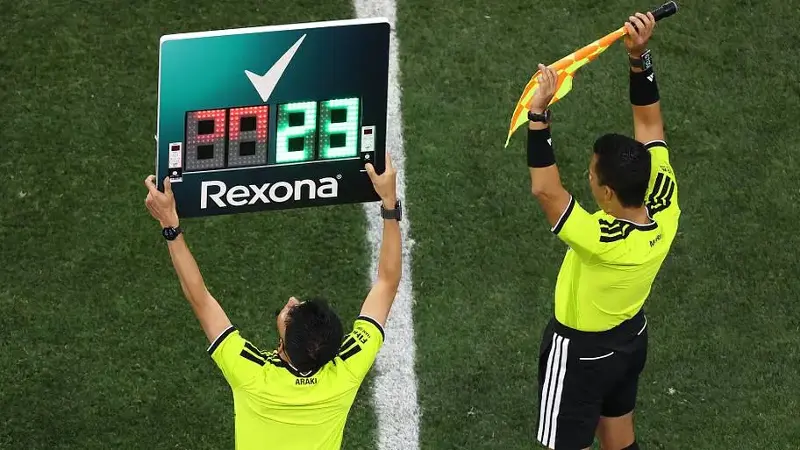
The fourth official, the one holding the light-up sign on the sideline, will indicate which player is coming off and which player is going on. Then, and only then, can a substitution be made. The player coming off the pitch must reach the sideline (any sideline) before the player entering may step onto the field.
Any player can be substituted at any time, but the only instance in which the procedure is altered is if a goalie receives a red card and is ejected from the game. The dismissed keeper can be replaced with another keeper, but a non-goalie player currently on the pitch must also come off in order for a team to be relegated to 10 men for the remainder of play.
History of the substitution at the FIFA World Cup
The substitution rules in soccer have not been the same throughout the history of the game. In fact, the rules were altered at each of the previous two FIFA World Cups—mostly due to increased concern over heat-induced fatigue and sustained concussions.
The 2022 World Cup in Qatar saw the introduction of the current five-sub rule. However, the early generations of the sport had to really tough things out. From 1930 until 1970 the 22 players on the pitch were committed to at least 90 minutes. When the World Cup was played on North American soil for the very first time (Mexico 1970), teams were given two precious substitutions.
Injured goalkeepers who were replaced were excluded from the two-sub limit starting in 1994 (USA) and then teams were granted three regular substitutions in 1998 (France). That lasted until 2018 (Russia) when an additional substitution (in extra time only) was permitted.
With record-high temperatures expected throughout the 2026 tournament, teams are likely to exhaust all of their available substitutions to keep their squads as fresh as possible. Keep an eye out for how the process goes down as you tune in this summer.
More World Cup news and analysis:
- America’s diversity has made it the perfect World Cup host
- Christian Pulisic's injury places these three USMNT stars under even more pressure
- Every World Cup record at stake for Lionel Messi and Argentina this summer
- When does the 2026 World Cup end? Final date, schedule and matches remaining