



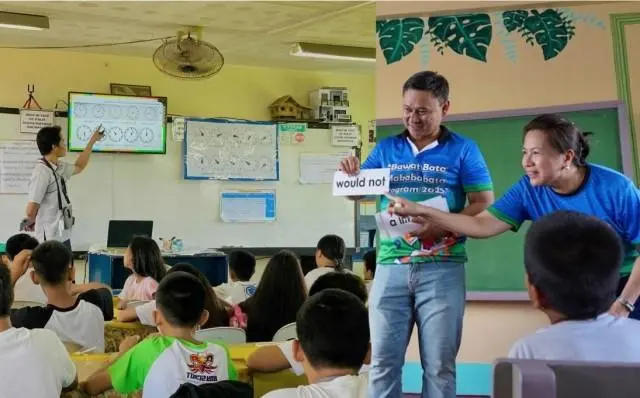
The Department of Education (DepEd) will implement an expanded set of summer remediation programs from May 6 to June 3, 2026, targeting millions of learners at risk of falling behind, as part of efforts to strengthen foundational skills and ensure grade-level readiness.
In a statement Tuesday, Education Secretary Sonny Angara said the initiative underscores the agency’s commitment to ensure that no learner is left behind.
“Tungkulin nating siguruhin na ang bawat mag-aaral ay may sapat na suporta. Narito ang DepEd para alalayan ang ating mga mag-aaral na mapaghusay ang kanilang kaalaman,” Angara said.
(It is our duty to ensure that every learner has adequate support. DepEd is here to guide our students in improving their knowledge.)
He added that with the support of President Ferdinand Marcos Jr., the agency is strengthening education programs to improve learning outcomes.
At the core of the initiative is the Academic Recovery and Accessible Learning (ARAL) program, a flagship intervention designed to improve reading and mathematics skills among about 3.7 million incoming Grade 2 to Grade 11 learners.
For students nearing graduation, the Senior High School Remediation program will provide targeted support to around 2.1 million incoming Grade 12 learners, focusing on core competencies in English, Filipino, and Mathematics.
Meanwhile, the Summer Academic Remedial Program will assist about 141,000 learners across grade levels who failed to meet required competencies in one or two subject areas.
DepEd said early results from its interventions show notable improvements.
Data comparing Beginning-of-School-Year (BOSY) and End-of-School-Year (EOSY) assessments indicate that literacy gaps have narrowed by an average of 33 percentage points in Grades 1 to 3, 16 percentage points in Grades 4 to 6, and 28 percentage points in Grades 7 to 10.
To support implementation, the agency is mobilizing around 607,000 teachers and volunteer tutors nationwide to provide more personalized academic assistance.
The program also adopts a holistic approach, including the provision of learning materials, incentives for educators, and health interventions such as vision and hearing screenings, as well as free meals.
Angara emphasized the importance of collaboration between schools and families in ensuring the program’s success.
“Nananawagan tayo sa ating mga magulang at guro na magkaisa sa mahalagang adhikaing ito. Ang ating pagtutulungan ang magsisilbing matibay na pundasyon upang maging matagumpay ang balik-eskwela ng ating mga kabataan,” he said.
(We are calling on parents and teachers to unite in this important endeavor. Our cooperation will serve as a strong foundation for the successful return to school of our youth.)
The initiative builds on Republic Act No. 12028, which institutionalizes academic recovery programs. Angara, a co-author of the law during his time in the Senate, signed its implementing rules and regulations in December 2024 as Education Secretary.
Under the law, ARAL tutors may include licensed teachers, para-teachers, pre-service teachers, and other qualified individuals, provided they meet DepEd competency and professional standards.—MCG, GMA News