


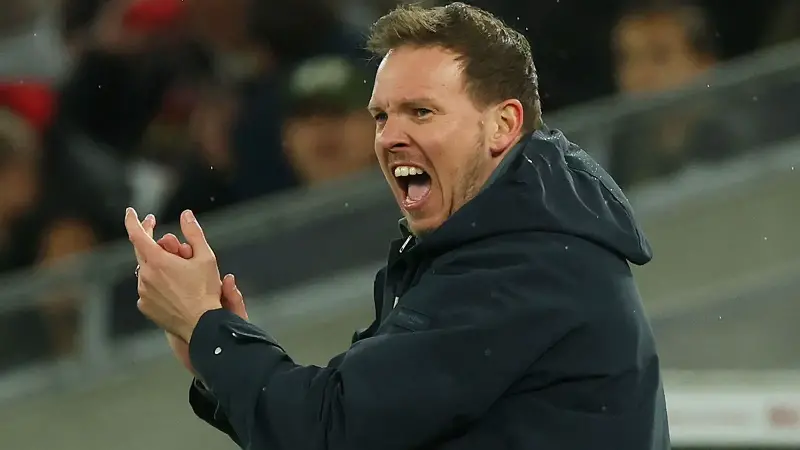
The German national team’s two friendly wins were accompanied by plenty of discussion about Julian Nagelsmann’s decisions, actions and comments. In the end, the national coach was largely proven right!
March was supposed to mark the start of the German national team’s big World Cup redemption. Following their early group-stage exits in Russia and Qatar, and a European Championship on home soil that was ultimately a mixed bag, the whole of Germany is desperate for a successful showing overseas.
But the month had barely begun when Julian Nagelsmann caused a real stir on the very first evening with his interview in kicker. Discussions as far as the eye can see. It felt as though every other statement could have served as the basis for a full evening’s pub chat. Some of Nagelsmann’s words were contradictory or, in the case of Aleksandar Pavlovic’s development during his time at FC Bayern Munich, even incorrect. Others were simply questionable.
And even in the run-up to the two friendlies, the 38-year-old stuck to his guns. Nagelsmann faced the backlash during the usual marathon of questions at the press conference announcing his squad selection, answering honestly and in his usual detail, and in doing so ruffled a few feathers. Whilst numerous fans and some journalists accused him of self-promotional behaviour – as had already happened in Munich – his controversial statements initially (!) proved one thing above all else: he was right!
Nagelsmann’s approach of explaining and elaborating on his decisions down to the smallest detail is, of course, a matter of taste – and at times a tad over the top. Nevertheless, the players seem to know where they stand under his leadership and how plans are made for them. That may perhaps lead to some gnashing of teeth. However, when looking at the team sheet before a match, there is certainly no cause for astonishment or discontent. After all, Nagelsmann has held the ‘role discussions’ he apparently loves so much with every single one of his players and has assembled his squad accordingly. Anyone who doesn’t fancy sitting on the bench isn’t even taken along in the first place.
This became particularly clear after the Ghana match, especially regarding the much-discussed selection of Deniz Undav. As announced, Nick Woltemade – who had already come on as a substitute against Switzerland in place of his former VfB teammate – was given the nod over the statistically proven top German goalscorer of the current season (23 goals, 13 assists). The tall striker is “not having an easy time of it at Newcastle at the moment,” Nagelsmann explained after the final whistle, backing up his decision with a dig at the country’s many amateur psychologists.
Undav backs up Nagelsmann's comments on the pitch
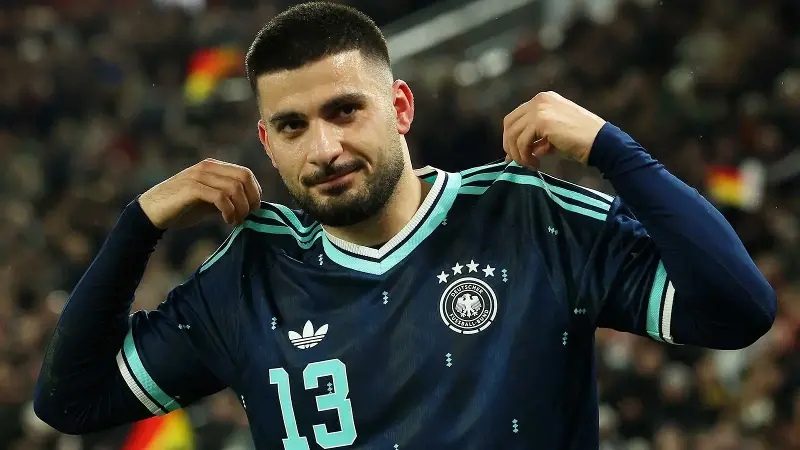
Woltemade repaid Nagelsmann’s faith with a thoroughly impressive performance. Undav, meanwhile, came on after the break for Kai Havertz, who was once again in fine form; according to many fans, Havertz should have been preferred due to Undav’s long spell on the sidelines. Undav’s substitution had already been called for in the first half by the German supporters present in his adopted home of Stuttgart, with chants that were impossible to ignore.
However, Nagelsmann once again justified his decision not to include Undav in the starting line-up ahead of the match on ARD by stating that he was “more of a finisher” and came into his own “when the opposition are already tired. His qualities tend to fade a bit when he has to work hard during the game.” If he were to backtrack, he could, moreover, “forget about his credibility”. Shortly before the end, Undav scored, netting the 2-1 winner to the frenetic cheers of the fans. The general consensus could now be: Undav has shown Nagelsmann!
However, that doesn’t quite reflect reality – and that’s unlikely to please some critical fans. For Undav confirmed Nagelsmann’s assessment from the very first second after coming on as a substitute. In one half, Undav touched the ball just 13 times, played two misplaced passes and lost both of his challenges. The striker, who was poorly integrated into the game, fulfilled only his role as a finisher with flying colours. He subsequently claimed that, whilst he was aware of his role following a “conversation with the national team coach”, this “might perhaps change as a result of goals like that”.
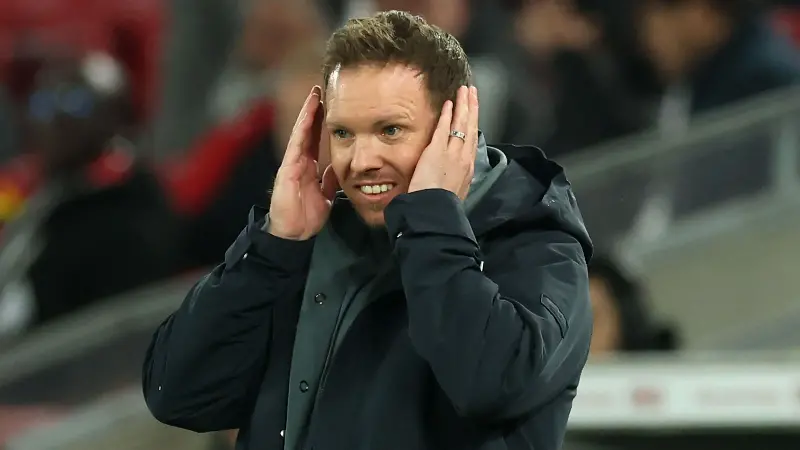
Nagelsmann himself made it clear afterwards, however, that “it is rather unlikely” that anything would change. When asked again about the role, he therefore explained with a serious expression: “Rather unlikely; I’m not having these role discussions for March, but for the World Cup.” And thanks to the clear communication within the DFB squad, Undav is also aware of this, as he added after expressing his hope: “I accept it.” In fact, Undav scored the majority of his goals (16 out of 23) for VfB in the second half, thereby supporting Nagelsmann’s earlier reasoning.
Nevertheless, his statement at the subsequent press conference was, once again, at the very least unfortunate, suggesting that Undav would be putting himself under pressure with his desire for a starting place: "From that perspective, it’s fine by me as soon as he starts scoring fewer goals. If he can cope with that himself, he’s welcome to do so."
Nagelsmann is right, and not just when it comes to Undav
Even setting aside the simmering debate over the strikers – Undav, Havertz and Woltemade – Nagelsmann’s decisions largely proved to be the right ones. Take, for example, the equally controversial selection of Leroy Sané, who had been out of form and was even booed in Stuttgart, yet who, following his lacklustre performance in Switzerland, set up Undav’s goal with a crucial run. Or the de facto guarantee of a starting place for Leon Goretzka, who came off the bench to make an immediate impact in the role Nagelsmann wanted him to play as a breaking number eight and set up the 2-1 goal superbly. Or Joshua Kimmich, who many felt was being wasted as a right-back but was hardly less involved in the game thanks to his interpretation of the role. Defensively, he certainly left spaces open, as with the Swiss national team’s first goal on Friday, but his replacement, Josha Vagnoman, certainly did no better against Ghana and was even at fault for the equaliser. Or the fact that Angelo Stiller was initially absent from the squad and was only called up as a late replacement due to the absences of Pavlovic and Felix Nmecha, yet failed to shine in either of his two starts and played at best solidly.
What remains are two victories which, with certain – though not insurmountable – caveats, offer genuine hope, from a purely sporting perspective, of finally achieving success at a World Cup once again.
If things don’t work out, the powder keg Nagelsmann is sitting on – which he has undoubtedly added to himself – would explode anyway. However, if the national coach continues to show a knack for getting things right, he could defuse it – and would also provide those fans with the World Cup euphoria they so sorely miss.
DFB squad: The German national team’s upcoming friendlies ahead of the World Cup
| Date | Time | Opponent | Venue |
| 31 May | 8.45 pm | Finland | Mainz, Germany |
| 6 June | 8.30 pm | USA | Chicago, USA |