



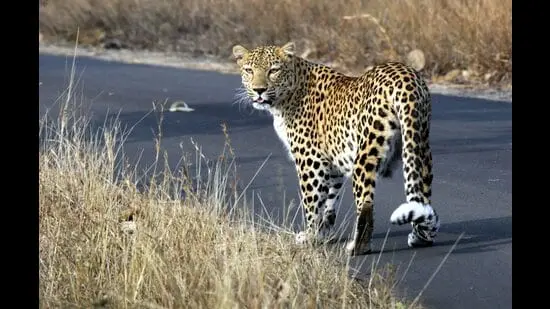
In an unusual attempt to reduce rising leopard attacks and prevent the big cats from straying into villages, Maharashtra forest minister Ganesh Naik on Tuesday said that the department plans to release tagged goats inside forest stretches to serve as an alternative prey base for leopards. The proposal, which includes a budget of ₹1 crore per district, is awaiting formal approval but goats have “reportedly already been released in some parts of Pune district”, Naik told the media in Nagpur on Tuesday.
Naik urged villagers not to harm the tagged goats, emphasising that the animals are being released specifically to keep leopards away from human settlements. The idea-suggested by some retired forest officials-is intended to ensure that leopards do not venture into villages and sugarcane belts in search of livestock or domestic animals.
The move has sparked debate in conservation circles, with experts warning that releasing livestock into forests may create more ecological challenges, encourage dependency among carnivores, or disrupt existing prey dynamics. Officials, however, argue that the measure is intended only for districts facing an acute conflict cycle.
The goat-release proposal comes amid a series of leopard sightings and conflict incidents across the state. On December 9, a leopard was spotted in a residential area in Alibaug, while another entered a neighbourhood in Nagpur a day later—close to the winter assembly session—necessitating rapid capture by forest teams. Such incidents reflect the growing overlap between human habitation and leopard movement corridors as agricultural landscapes expand and forest buffers shrink.
Alongside the prey-base plan, the forest department has prepared a draft shifting the leopard from Schedule I to Schedule II of the Wildlife Protection Act. The reclassification is expected to make it easier for frontline forest staff to issue capture orders and respond swiftly during conflict situations without having to seek permissions from the principal chief conservator of forests in Nagpur.
Ashish Thakare, chief conservator of forests, Pune Forest Circle, said the draft was submitted last month. “It will go before the state legislature, following which a bill will be drafted. After the Governor’s approval, it will be forwarded to the Centre. It is a lengthy process, but considering the seriousness of the situation, we expect the state government to expedite it,” he said.
For now, the draft focuses on leopards frequently operating outside forested areas, especially in sugarcane belts, where most encounters take place. If approved, local forest divisions will gain greater autonomy to manage emergencies and ensure public safety.
Even as the legislative process moves ahead, the proposed goat-release initiative-already in partial implementation in Pune-has become the most talked-about measure, drawing both curiosity and caution as the state searches for ways to contain one of its most persistent wildlife conflicts.