



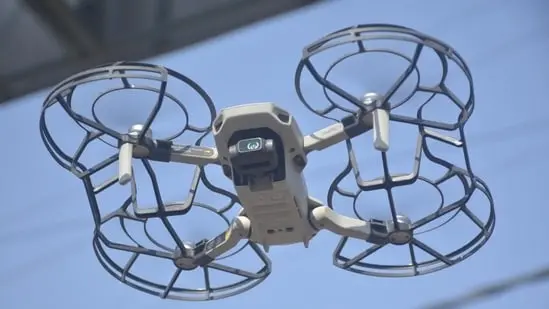
The story of Indian agriculture has always been one of resilience, innovation, and reinvention. From the Green Revolution that turned India from a food-deficit nation to a food exporter, to today’s era of climate-smart, technology-led farming — every transformation has reflected the spirit of Bharat: adapting to new challenges with indigenous solutions.
Now, India stands on the threshold of another defining leap — the Drone Revolution in agriculture. The government’s visionary push for the adoption of Kisan Drones is not just a policy intervention; it is a movement that blends technology, empowerment, and sustainability into one cohesive national mission.
Recognising the transformative potential of drones in modern agriculture, the Department of Agriculture and Farmers Welfare (DA&FW) has launched a comprehensive initiative under the Sub-Mission on Agricultural Mechanisation (SMAM). Since 2021–22, funds amounting to ₹141.39 crore have been allocated to promote the use of Kisan Drones — enabling farmers to purchase drones, set up Custom Hiring Centres (CHCs) for rental services, and participate in live field demonstrations across the country.
Institutions under the Indian Council of Agricultural Research (ICAR) — including 100 Krishi Vigyan Kendras (KVKs), 75 ICAR institutes, and 25 State Agricultural Universities (SAUs) — have already conducted over 27,000 drone demonstrations across 30,000 hectares, showcasing real-world benefits in nutrient, fertiliser, and pesticide application.
But this revolution goes beyond efficiency — it redefines how farmers engage with science. A farmer using a Kisan Drone today is not merely applying fertiliser; he is engaging in precision agriculture, where every droplet, every acre, and every decision is data-driven.
One of the most inspiring aspects of this movement is the Namo Drone Didi scheme — a flagship initiative that embodies the spirit of Atmanirbhar Bharat and Nari Shakti. Approved as a central sector scheme with an outlay of ₹1,261 crore for 2023–26, the initiative aims to provide 15,000 drones to Women Self-Help Groups (SHGs) across India.
Under this programme, women are being trained as drone pilots and entrepreneurs, receiving 80% central financial assistance (up to ₹8 lakh per drone) along with comprehensive training, maintenance support, and insurance.
Already, over 1,094 drones have been distributed, with 500 under the Namo Drone Didi Scheme. These women are not just operating machines — they are piloting change. They represent a new generation of agri-technologists from rural India who are bridging the gender and technology divide simultaneously.
The preliminary findings from studies conducted by the Agricultural Development and Rural Transformation Centre (ADRTC), Bengaluru, indicate clear benefits. Farmers have shown willingness to adopt drone spraying services at about ₹400 per acre, reporting savings in water, fertilisers, and labour, while achieving higher productivity.
The message is clear — technology that empowers women ultimately strengthens the nation’s agricultural base.
The introduction of Kisan Drones has fundamentally altered the economics of Indian farming. Drones can spray fertilisers and pesticides up to 40 times faster than manual methods, significantly reducing input costs and exposure risks for farmers. With AI and IoT integration, they can analyse crop health, identify pest infestations, and optimize irrigation — turning traditional farming into a data-intelligent ecosystem.
But like every emerging technology, challenges remain. Limited crop-specific expertise, lack of hands-on training, and logistical issues like battery shortages need to be addressed. The Standard Operating Procedures (SOPs) released by DA&FW and the Directorate General of Civil Aviation (DGCA) have been pivotal in ensuring safety, consistency, and scalability.
The recently released SOPs for pesticide and nutrient spraying across 10 major crops are a crucial step toward standardising drone usage in diverse agro-climatic conditions. Combined with robust training programmes for drone pilots and assistants, these frameworks ensure that innovation remains both safe and sustainable.
The larger vision is clear: India must not only use drones but also design, manufacture, and export them. This is where Make in India finds its truest expression.
For instance, drones are being designed and developed with Indian conditions, crops, and climates in mind. From rugged hardware that withstands field conditions to software built for local languages and connectivity challenges, these innovations reflect a deep commitment to “Make in India, Made for the World.”
The impact extends beyond agriculture. Drones are finding applications in disaster management, infrastructure inspection, and national security — sectors that are increasingly interlinked with rural resilience and productivity.
To unlock the full potential of the drone ecosystem, three things must converge — policy vision, private innovation, and public participation.
First, policy continuity is crucial. Initiatives like SMAM and Namo Drone Didi must be institutionalised with long-term funding, ensuring scalability beyond pilot phases.
Second, industry and startups must be encouraged through R&D grants, preferential procurement, and export incentives. Building indigenous supply chains for drone components — batteries, sensors, and software — will ensure strategic autonomy and economic multiplier effects.
Third, the creation of Drone Training Hubs at agricultural universities, polytechnics, and ITIs can democratise access to drone education. A generation of Kisan technocrats can emerge — equally adept at managing soil health and software systems.
Drones are not just machines of efficiency; they are symbols of a new rural imagination — one where farmers are innovators, women are pilots of progress, and agriculture is guided by data, not dependency.
India’s agricultural future will not be written in isolation but in integration — of tradition with technology, of grassroots wisdom with global innovation. The promotion of drones in agriculture is not merely a technological intervention; it is a national investment in self-reliance, productivity, and pride.
This article is authored by M Chuba Ao, national vice president, BJP and Nagender Parashar, director, Parashar Industries.