



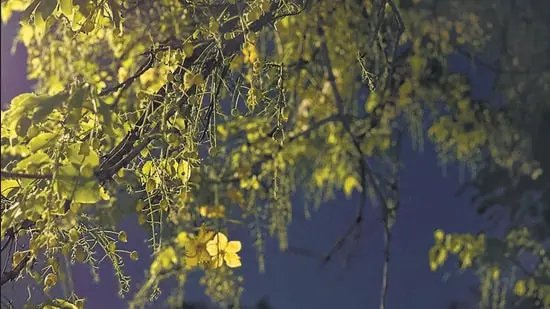
The 40-degree Celsius afternoon is searing the skin, filling the mind with dread for the extreme heat ahead. At a traffic light in the central parts of the city, cars and autos are jamming up in a tight knot as hawkers and beggars weave between them. A roadside statue of a long-dead leader is covered with birds and bird droppings. Indeed, our smoggy, dusty megapolis seems to have reached its bleakest hour. Suddenly, the tired eyes chance upon a refreshing spectacle. A tiny cluster of flowers is hanging from a tree branch. Five-petalled, bright yellow.
It is the Amaltas!
It is still early in the season; most Amaltas trees in Delhi-NCR are yet to bloom. On the Second Avenue Road, near Khanna Market, an Amaltas tree that always turns fully yellow in May and June is not yet showing a single flower.
It is understandable that so many of us dread the summer. But the city is most striking during this hostile season. Over the forthcoming months, the city’s Amaltas trees will burst into a great smudge of dense yellow. Some roadsides will then entirely be lit up in that colour. Elsewhere, a single tree will valiantly offer the necessary relief—its yellow bloom standing like an oasis of beauty under a punishing sun.
Amaltas is said to have uses in traditional medicine, but it is the visual force that matters. Soon, the yellow flowers will come into view across many localities, such as Bungalow Road, Shanti Path, the Humayun’s Tomb grounds, Nicholson Cemetery, Vasant Vihar lanes, Buddha Garden, and many others. Every summer, for instance, the posh Amrita Shergil Marg is totally taken over by Amaltas flowers—their yellow briefly underwhelming the rich people’s housing. A more emotional drama unfolds on Hailey Road in central Delhi, which is lined with a massive number of Amaltas trees. During the peak heatwave, the yellow flowers get as thick along the road as Delhiwale lining up to watch the Republic Day Parade.
The word “Amaltas,” meanwhile, has taken on a life of its own. Across the Delhi region, it appears in hotel names, apartment blocks, and restaurants. Maybe because the name suggests beauty and shade in a harsh climate. At the India Habitat Centre (IHC), the Amaltas Hall upholds the typical IHC-style time-pass, where attendees pretend to listen to argumentative panellists while day-dreaming about the lunch buffet promised at the end of the seminar. In Gurugram, a posh enclave has a road named Amaltas Drive. In Green Park, a hotel has named itself after the Amaltas.
One night last week, on a deserted road near Gole Market, a tree was sighted, bearing its early Amaltas blossoms. Just two yellow flowers, one shinier than the other! They were suspended like teeny-weeny chandeliers. See photo.