



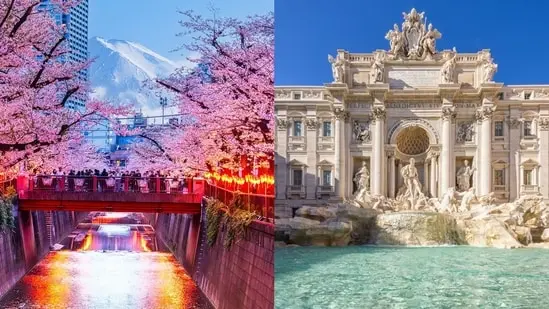
If you're wondering why tourism-sustained or led economies would have an issue with bourgeoning tourist footfall, your answer is overtourism.
Put simply, overtourism arises when visitor numbers surpass a destination’s ability to manage them sustainably, causing serious strain on local life, infrastructure and the environment. It is typically marked by a shared sense among residents and travellers that the place has become overcrowded, leading to degraded experiences and harm to local culture.
And Mount Fuji in Japan is the latest to bite the dust in this regard. Here's taking a look at that, and other much-sought after destinations that are actively attempting to put stops to overtourism.
Japan
The Cherry Blossom Festival, a bucket list moment on every avid travellers list out there, has been scrapped for 2026. And the reason isn't environmental or ecological. As a matter of fact, a BBC report on the development cleanly pegs the decision as having been motivated by "badly behaved tourists."
The announcement was made by Fujiyoshida authorities, earlier this week on Tuesday, also directly citing the 'overtourism crisis' as the key driving factor. Known to draw more than 200,000 visitors every year, the sharp rise in international arrivals has reportedly made daily life increasingly difficult for locals. For context, Japan threw its doors open to 42.7 million visitors in 2025. Mayor Shigeru Horiuchi pointedly affirmed how residents' "quiet lives" with reports of tourists entering private homes to use bathrooms, straying into gardens and leaving litter behind being used to highlight the logic behind the severity of their stance.
Italy
Rome has implemented a modest access charge for visitors wishing to experience the Trevi Fountain up close, signaling a new approach to managing crowds at one of the city’s most popular attractions. Starting February 1, 2026, tourists are paying €2 (approximately ₹210) to enter the designated viewing zone nearest the fountain between 9AM and 9PM, the peak hours for visitor traffic. The fee isn't really about earning revenue for the city authorities. It's a definitive crowd control measure. During peak hours, the fountain draws thousands of visitors, frequently clogging the narrow streets leading into the square. By limiting daytime access to the basin’s edge, authorities are hoping to ease congestion, enhance safety and safeguard the monument. Additionally, Roman locals are exempt from this nominal fee which makes this is a tourist-special measure.
France
Home of the iconic Cannes Film Festival, year on year, has clearly painted the French Riviera as the Mecca of both cinema and fashion. And that is troublesome to the authorities. In an effort to address overtourism, Cannes has now decided to only permit ships which are "less numerous… less polluting, and more aesthetic." Specifically, a Travel+Leisure report spells out the guidelines as follows - only cruise ships carrying fewer than 1,000 passengers may enter the port, daily disembarkations will be capped at 6,000 people, and larger vessels will have to shuttle visitors ashore using smaller boats.
Greece
Cruise passengers arriving in Greece now pay a disembarkation fee introduced last year to curb overtourism on its busiest islands. The entry fee is set at €12 for Santorini and Mykonos and €3 for other ports during non-busy stretches, with the same rising to €20 and €5 respectively, during peak footfall. The primary goal, again, is to ease congestion at destinations that tend to welcome over 8 million cruise visitors, as per 2024 stats.
Which of these dream destinations was on your bucket list?