



At the Bombay Natural History Society’s quarterly meeting on October 4, 1887, an exhibition displayed the season’s fruits and vegetables in Bombay, featuring 175 varieties, many sourced from private gardens.
Dr Kanhoba Ranchhoddas Kirtikar, an army surgeon and amateur botanist, presented a list of vegetables obtained from Crawford Market and briefly described the uses of several items.
He highlighted a rare vegetable from the largely unfamiliar grass family: the tender shoots of bamboo (Bambusa arundinacea), known to Hindus as “vasota,” which were prized for making a pickle with sour lime juice and salt.
Freed from the sheaths and hairs, they were cut up into small pieces and eaten in curries. They were also made into preserves. The very young shoots of some species of bamboo, if boiled in water with a little salt, resembled an inferior quality of asparagus.
According to “The Cyclopaedia of India” by Edward Balfour, the Chinese candied many things which “were not considered fit for such purposes elsewhere, as millet seeds, bamboo shoots, slices of the lily root, etc”. These were hawked about the streets of Bombay and were sometimes available in Poona.
Inside the hollow stems of some bamboos, chiefly Bambusa arundinacea, a siliceous and crystalline substance was found, known in the bazars of India as “Tabashir”. It was considered “cooling, tonic, aphrodisiac, and pectoral”.
Probably no plants were more valuable to the inhabitants of India than the graceful, gigantic grasses, popularly and collectively known as Bamboos.
The holiness of bamboo was perhaps, for the most part, due to its fire-yielding properties and partly to its medicinal virtues. Sir James MacNabb Campbell mentioned in the “Notes on the Spirit Basis of Belief and Custom” (1885) that the decoction of bamboo root was cold-giving and considered useful for diabetes and other urinary diseases. The bamboo leaves were considered useful for removing bile and intense heat in the body.
Among the Dhruva Prabhus of Poona, at their wedding, bamboo baskets were put on the heads of the bride and bridegroom and guests, and in certain other castes, the bride and bridegroom were made to stand in bamboo baskets. A bamboo pole was the emblem of many Konkan village deities, and bamboo marrow was the first food given by the “kolis”, the fishing community, in Deccan and Konkan, to their children.
Bambusa arundinacea was the large thorny bamboo, common throughout the Presidency, usually in deciduous forests. Bambusa vulgaris was cultivated in Poona and was a popular ornamental grass.
The bamboo grown in and around Poona was edible but bitter. The shoots were rare and costly in the Poona markets. They had to be cooked thoroughly and for a long time to remove the toxins and bitterness. They were not consumed by the so-called “upper castes” in the city.
It was believed that the shoots appeared after thunder in the rainy season. But during the months in which the bamboo shoots appeared, the climate of the most important bamboo forests was such that labour could not be obtained. Bamboo forests occupied, as a rule, uninhabited districts, rendering the labour question, apart from the dangers to human life, one of the most serious difficulties.
On September 13, 1904, a Bombay newspaper published an article titled “Bamboo cultivation in the Presidency”, which was largely based on a report published in the “Tropical Agriculturist” on June 1, 1904.
The article mentioned that, like in Ceylon, bamboo could not be said to be truly cultivated in India, though the “sticks” were pretty largely produced and extensively used in making baskets or erecting temporary structures and scaffolding. Mr David Fairchild, Agricultural Explorer, USA, was convinced that the edible species of bamboo in Japan would do really well in Ceylon. The Bombay newspaper requested the agriculturists in Bombay and Poona to try and cultivate the edible species in the Presidency and popularise the consumption of the bamboo shoot among Europeans and Indians.
Only one species of bamboo was commonly grown in the early twentieth century- Japan for food, and was known as “Moso” (Phyllostachys mitis). It was introduced from China, where its value as a food plant had been known for centuries, and its common name indicated its origin.
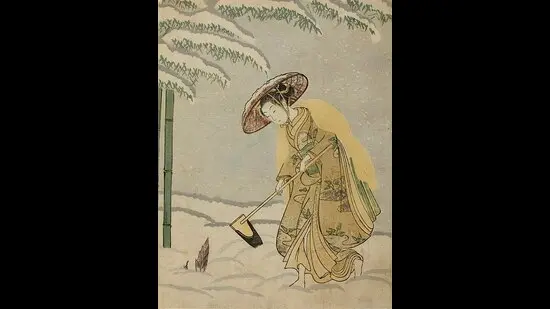
Moso was the name of one of the twenty-four paragons of Chinese filial piety. The story was the case of a boy whose widowed mother fell ill and longed for broth made of young bamboo shoots. The shoots not being procurable in winter, his devotion was such that he went out in the snow to dig for them. The god rewarded his devotion by causing the shoots to grow suddenly to an unheard-of size. Japanese artists were fond of illustrating their works of art with drawings of the boy Moso.
One other sort, Phyllostachys aurea, was also said to have edible shoots, but those of the remaining kinds were understood to be too bitter to be eaten.
The method of cultivating this species differed from that employed for the timber sorts. The best soil was a more friable one, and if not naturally with a good admixture of sand, it was supposed to be top dressed every year with one inch of light sandy loam and a mulching of straw or grass and weeds cut from the meadow. Liquid manure was given freely to the newly set out plants, and as long as they were grown for their edible shoots, large amounts of rich fertiliser containing much soluble nitrogen were to be supplied to them.
Although very nutritious, bamboo shoots were not easily digested, and many Americans did not like them for this reason, wrote the “Tropical Agriculturist”. However, the journal believed that the American population could grow very fond of them and adapt them to their “Western menu”.
Miss Fanny Eldredge, of Yokohama, had furnished a few recipes in the article for cooking bamboo shoots. One of them was “Bamboo sprouts with cream sauce”: These sprouts are cut when about a foot above the ground, by digging down to the rhizomes which bear them. After being gathered, the outside sheaths are removed, and the shoots are soaked for half an hour in cold water. They are then cut into thin slices, about 3 inches long by one inch square, and thrown into boiling water containing a small teaspoonful of salt, and are boiled from an hour to an hour and a half, or until tender. The pieces are then drained, and a white sauce is poured over them, which is made in the following way: To a half pint of cream or milk, add a teaspoonful of butter, season with salt and black pepper. Allow this to boil up and serve at once. If desired, this sauce may be thickened with flour.
But the affinity of the Chinese expats and poor natives from regions like Assam for the bamboo shoot made Europeans in India abhor it. It was considered lowly and not fit for the consumption of the “white man”. No wonder the proposal to plant edible species of the Japanese bamboo in Poona and Bombay was never implemented.