



There are some policy actions that would normally be given the benefit of the doubt and not be seen ab initio as either a conspiracy to serve an obscure political agenda or consciously designed to make an existing scheme less effective. I would have thought that the Viksit Bharat Guarantee for Rozgar And Ajeevika Mission (Gramin) (VB-G RAM G) is such a policy legislation. In all other democracies with a mature opposition, VB-G RAM G would have received bipartisan support and all state governments, irrespective of their political affiliations, would get on with the job of the effective implementation of the revised scheme. But alas, not so in our country.
Those who see a Right-wing conspiracy in every government action have raised the cry that the name has been changed such that the acronym G RAM G is included. This, it is assumed, will become the default title of the scheme and serve a particular political agenda. The default usage could as easily be GRAMIN, which already finds mention in some government press releases. And it sounds far more appropriate, referring as it does to a rural scheme. To avoid any possible controversy, we may be better off with standardising the use of GRAMIN as an acronym for the revamped scheme.
Some commentators (Karthik Muralidharan and Sandip Sukhtankar, HT) have rightly emphasised that the key driver of the Mahatma Gandhi National Rural Employment Guarantee Scheme (MNREGS)’s success was its effective implementation. GRAMIN has several in-built features that will help achieve this. First, its sharp focus on four key sectors and specially on water conservation projects will ensure positive impact. Second, being a part of the plans designed by the gram panchayats, will put GRAMIN projects in sync with the holistic requirements of the village/region. Third, there is the provision of rigorous social audits twice a year. Fourth, the revamped scheme introduces a strong technology component in the operation of the scheme by providing for (i) biometric authentication, (ii) geospatial technology for planning and monitoring, (iii) mobile application-based dashboards for real-time tracking, and (iv) weekly public disclosure systems. This will surely improve accountability and also transparency in GRAMIN’s operations.
With the number of days for availing work under the scheme being increased from 100 to 125, it should be difficult to argue that GRAMIN is a “tamped down” version of its earlier avatar. The fear that by raising the share of the state governments to 40% the GRAMIN scheme will face fiscal constraints may be premature. Himalayan and Northeastern states (13 in all) will still receive 90% of the total outlays from the Union government. A higher share of 40% could imply that state governments — having to bear a higher share of the outlays — will have a higher incentive for building the required implementation capacity for GRAMIN projects. There is always a provision for higher Union government allocations in case a state is faced with acute distress and is unable to mobilise the required fiscal resources. The change from being a purely grant-based scheme to one in which the state governments have some fiscal responsibility is likely to improve the implementation of the projects under GRAMIN.
An outlay for each state, based on an in-depth enquiry of their actual needs, will ensure that state governments are fully aware of the annual outlay and can hence plan the implementation of GRAMIN more effectively to better tackle employment loss in lean months. The state-level steering committee will ensure that projects undertaken under GRAMIN converge with other programmes being implemented in the state. The coordination with the national steering committee will contribute to achieving a more appropriate allocation from the Centre.
The provision for pausing the implementation of GRAMIN for 60 days in a year to coincide with the peak agriculture seasons of sowing and harvesting in individual states is well-considered. It will help alleviate labour shortages that heavily constrain the farmers’ ability to complete necessary farm operations in time during the peak season.
The focus on four critical infrastructure, water conservation, rural infrastructure, infrastructure linked to livelihoods and mitigation of extreme climate events will give GRAMIN projects a sharper definition and remit. India is a severely water-stressed country, with 4% share of global fresh water and 16% of the world population. Our per capita water availability today is about 1,400 cubic metres, which is already below the water stress level defined as 1,700 cubic metres.
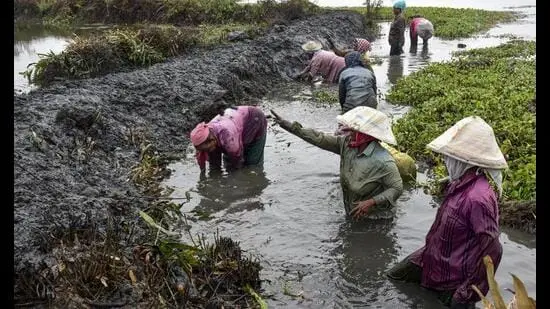
Therefore, the focus on rainwater harvesting, dredging of ponds and reservoirs to increase their water holding capacities and all other water conservation projects will address an acute problem.
Linking projects undertaken under GRAMIN to the National Rural Infrastructure Stack and to PM Gati Shakti and making these a part of the Viksit Gram Panchayat Plans in conjunction with its focus on four key sectors will ensure more bang for the buck. It will ensure that rural infrastructure projects are conceived and implemented as part of the decentralised development plans prepared by gram panchayats on the one hand and, on the other, converge with the national level effort to improve physical infrastructure and lower overall logistics costs in the economy. Improvements in rural infrastructure and linking it to the national logistics network will facilitate labour mobility and transfer of goods and services to the rural areas. This will directly benefit the rural workforce and farmers.
By locating GRAMIN firmly within the digital framework and establishing unambiguous and clearly defined regular monitoring mechanisms, we can expect that fake rolls, exaggerated employment claims, payment pendencies and leakages will be minimised and eventually eliminated. GRAMIN is an attempt to incorporate the lessons learnt from 20 years of operational experience under MNREGS and turn it into an effective social security net which will provide succour to people during times of distress and unforeseen loss of employment.
Rajiv Kumar is chairman, Pahlé India Foundation, and former vice-chairman, NITI Aayog. The views expressed are personal