



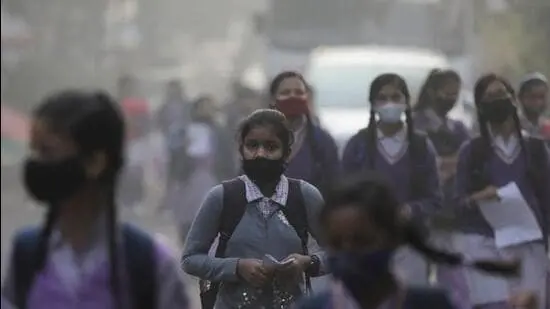
For years, Delhi has lived with the idea that closing doors and stepping indoors offers protection from toxic air. A week-long HT field experiment challenges that belief. By tracking particulate matter inside a school, AIIMS, a specialised pollution clinic and a home, reporters found that the city’s most vulnerable – children, patients, pregnant women – are often breathing air nearly as polluted indoors as outside. Only in a tightly controlled home environment, with an air purifier running continuously, did pollution fall to safer levels.
In classrooms, air that’s barely better than in the parking lot

While most parents may see schools as sanctuaries from the smog outside, the air inside one private school in Rohini’s Sector 5 tells a sobering story. As HT tracked the air quality inside and outside the campus – a school typical of many across the city, with no air purifiers in classrooms, it found numbers that left little room for reassurance.
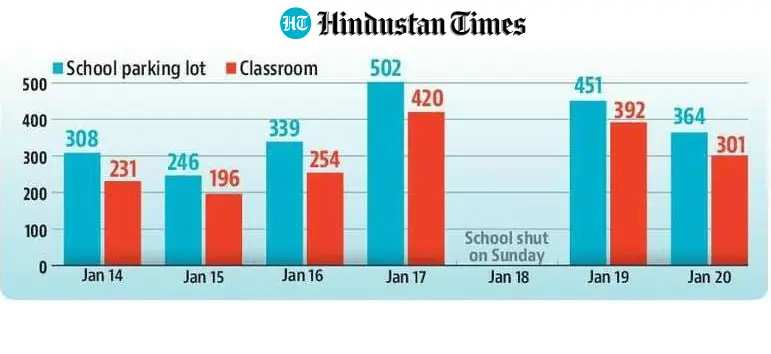
Outside the school gate and bus parking area, PM2.5 levels ranged from 246µg/m³ to a staggering 502µg/m³. Indoors, in spaces where children spend most of their day – shut classrooms, computer labs and even the principal’s office – readings ranged from 188µg/m³ to 404µg/m³. In corridors and semi-sheltered areas, pollution levels were almost indistinguishable from those outdoors, the readings showed. These readings were between three to seven times the safe level of 60µg/m³, according to Indian standards.
As the exercise took place during regular school hours, curious students came over to observe the findings. Most of them were shocked to learn about the pollution levels they were being exposed to despite being inside a school.
“I take out my mask only when I am inside the school and I carry warm drinking water to ensure I am drinking water that is dust free. But, with this level of pollution around me, I feel my efforts would do little to make things any better,” said a student of Class 5.
On the first day of monitoring, January 14, PM2.5 levels at the parking lot and playground stood at 308µg/m³ and 297µg/m³. Indoors, the readings dipped only marginally – 236µg/m³ in the principal’s office, 231µg/m³ inside a classroom, and 248µg/m³ in the computer lab. Over the next two days, pollution hovered in a similar range, before climbing sharply from January 16 onward.
January 17 marked the worst day of the exercise. At the parking bay, PM2.5 touched 502µg/m³ — the highest single reading recorded at the school during the week. Indoors, the air offered little relief: 432µg/m³ in the principal’s office, 421µg/m³ in the computer lab, 399µg/m³ in the counsellor’s room and 435µg/m³ in the corridors. This coincided with Delhi’s broader pollution spike, when the city’s 24-hour average AQI touched 400.
The school remained shut on Sunday, but when monitoring resumed, the pattern persisted. On Day 6, PM2.5 outside the main building was 451µg/m³. Inside, readings ranged from 404µg/m³ to 444µg/m³ across offices, labs and corridors. Even on the final day, when outdoor pollution eased slightly to 364µg/m³, indoor levels remained between 301µg/m³ and 339µg/m³.
Across the week, not a single reading met India’s safety standard of 60µg/m³. The highest daily average was recorded on Day 4 at 434.8µg/m³. Even the “best” day averaged 206.2µg/m³ – still more than three times the national safe limit.
Principal Jyoti Arora said the findings raise difficult questions. “We have a green campus, cleanliness is our top priority, and during peak pollution months we limit outdoor activities,” she said. “But with pollution at these levels, I am not sure what more can be done at the school level. Amidst all this, meeting the 220 academic days criterion becomes a challenge.”
For some educators, the data has become a lesson in itself. A senior coordinator said the crisis offers a stark teaching moment. “This is an eye-opener for students. It shows why respecting the environment is no longer optional – it’s essential.”
Even wards to heal the most vulnerable have polluted air
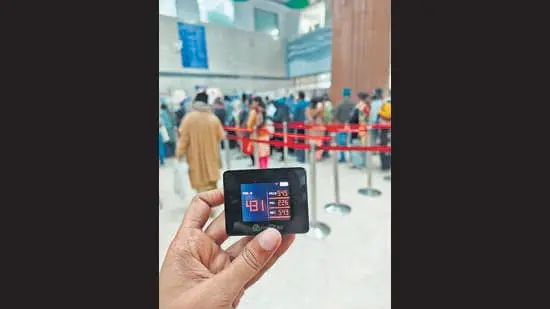
At the All India Institute of Medical Sciences (AIIMS), Delhi’s premier public hospital, the expectation is that the sick find protection within its walls. Yet a week-long monitoring exercise inside two of its most sensitive spaces – the Dr BR Ambedkar Institute Rotary Cancer Hospital and the Mother and Child Block – revealed PM2.5 levels consistently far above what is considered safe.
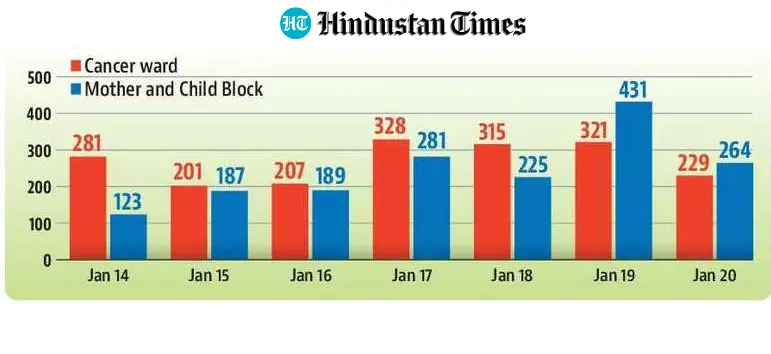
Inside the cancer ward, where patients with compromised immunity spend hours each day, the lowest PM2.5 reading recorded was 201µg/m³ on January 15 – over three times India’s 24-hour safety limit. The worst reading, logged on January 17, touched 431µg/m³.
Fine particulate matter at these levels is known to penetrate deep into the lungs and bloodstream, increasing the risk of respiratory illness, inflammation and weakened immunity — dangers that are particularly acute for cancer patients undergoing chemotherapy or radiation. Early mornings, when readings were taken, also coincide with peak patient crowds, further compounding exposure.
On January 17, the day with the highest average pollution levels at AIIMS, PM2.5 outside the cancer ward stood at 412µg/m³. Inside the waiting room, it measured 328µg/m³, dipping only slightly to 249µg/m³ in the corridor.
Among those exposed was Anmol, a 17-year-old undergoing treatment for brain cancer. “On OPD days, we are here for four to five hours. On radiation days, we spend the entire day here,” he said. “Doctors warn us about infections, but most patients don’t even know how bad the air is. It feels like we are coming to a more infection-prone place to get treatment.”
The situation was scarcely better in the Mother and Child Block, which houses gynaecology and paediatric OPDs, surgery wards and neonatal units. PM2.5 levels there ranged from around 120µg/m³ in parts of the ward on the best day to over 400µg/m³ on the worst. On January 14, the main waiting area recorded 123µg/m³. Five days later, the same spot registered 431µg/m³ — over seven times the national limit.
On most days, readings remained stubbornly between 180µg/m³ and 270µg/m³, indicating sustained exposure rather than short-lived spikes.
Kamla, who travels from Gwalior with her two-year-old for liver treatment, said the findings were unsettling. “We take precautions — masks, cabs, avoiding the outdoors. But if the air inside the hospital is also this bad, then what can we do?”
Public health experts warn that such conditions pose serious risks. A pulmonologist said patients with weakened immune systems, pregnant women and children are particularly vulnerable, as prolonged exposure can worsen inflammation, trigger infections and undermine recovery.
A special ‘pollution clinic’ struggling with toxic air
Delhi’s specialised air pollution clinic at Ram Manohar Lohia (RML) Hospital was set up to treat illnesses caused by toxic air. Yet even here, clean air remains elusive. During a separate monitoring exercise on Monday – the only day the clinic operates – PM2.5 levels inside the facility were recorded at 216µg/m³ around 2pm. That is 3.5 times India’s national safety limit and firmly in the “harmful” category, especially for patients already suffering from pollution-related ailments.
Located on the ground floor, the clinic offers integrated care across pulmonology, cardiology, ENT, ophthalmology, dermatology and psychiatry, acknowledging the multi-system impact of air pollution. Every Monday, between 60 and 80 patients pass through its doors, with footfall rising sharply during winter.
Health experts say polluted indoor air in such settings can undermine treatment itself. “Most patients coming to air pollution clinics already have compromised respiratory health,” said Dr Arun Kumar Giri, director, surgical oncology, Aakash Healthcare. “Exposure to polluted air inside hospital premises can aggravate symptoms and delay recovery. Clean air here is essential, not optional.”
Clean air is possible inside a home — but only with purifiers and constant vigilance
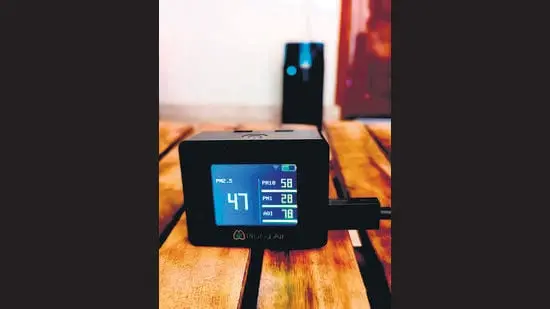
HT’s monitoring inside a west Delhi home in Vikaspuri shows that the refuge offered by a house from pollution is conditional, at best. Doors shut, windows sealed and purifier on at full blast – that’s the only way to breathe clean air at a house.

With an air purifier running in the bedroom, PM2.5 levels dropped to as low as 18µg/m³ -- an ideal scenario and a glimpse of what safe air can look like. On most days, readings with the purifier hovered between 20µg/m³ and 50µg/m³. Switch the machine off, however, and pollution surged rapidly, often climbing to four or five times the national limit.
On January 14, the exercise began with the purifier turned off. At 10am, PM2.5 stood at 338µg/m³. Within minutes of switching the purifier on, levels began to fall – to 129µg/m³ by 10.11am, 74µg/m³ by 10.15am, and below 60µg/m³ by 10.20am. For the next hour, readings stayed largely between 20µg/m³ and 40µg/m³.
The reverse was just as striking on January 20. With the purifier running, PM2.5 remained below 30µg/m³. Ten minutes after it was switched off, levels jumped to 238µg/m³ – this is despite doors and windows staying shut.
Experts say this reflects how most homes are built. “We assume homes are airtight, but they rarely are,” said Arun Sharma, professor of community medicine at UCMS. “When pollution outside is high, it leaks indoors almost instantly. Indoor sources like cooking, agarbattis and room fresheners can worsen it.”
Until Delhi’s outdoor air improves, Sharma said, clean indoor air will remain a privilege –dependent purely on machines, vigilance and constant purifying power.