



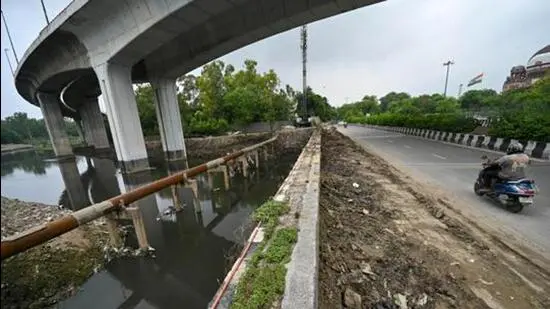
The Delhi Jal Board (DJB) has informed the National Green Tribunal (NGT) that it has intercepted and diverted sewage from 10 out of 43 identified drains that were polluting the Barapullah drain. Work to similarly “trap” another 25 drains is targeted for completion by June 30, 2026.
In a new status report submitted to the green court on January 1, DJB said that work on setting up 34 new decentralised STPs to handle Delhi’s sewage waste is also in progress, with 13 of these expected to be completed by the end of next year and the remainder by the end of 2028.
The process of “trapping” involves containing all pollutants from a drain and diverting the flow to a sewage treatment plant (STP) instead of letting it discharge into stormwater drains.
The NGT is hearing multiple petitions, including one from residents of Nizamuddin West, who have raised concerns about waterlogging caused by clogged drains during monsoons. The report also said the water utility was following the principle of “trapping drains at source” to prevent sewage from entering stormwater drains, adding 15 major drains in Delhi had already been trapped this way.
Referring to the 43 sub-drains identified last year through which sewage was reaching the Barapullah drain, which eventually carries sewage to the Yamuna, DJB has shared a timeline, adding 10 such sub-drains had already been trapped, with the sewage now going to sewage treatment plants (STPs). For another 25, the timeline set is June 30, 2026, it said.
“Works at certain locations are in progress, while estimates have been framed and administrative approvals are being processed in others. In cases involving JJ clusters, forest land or jurisdictional issues, DJB has initiated coordination with agencies such as DUSIB, NDMC, forest department and revenue authorities to ensure creation of a single point sewage collection and lawful interception,” the report adds.
Work is underway on 34 new DSTPs, with 13 expected to be operational by the end of 2025 and the remainder by 2028. Tenders for 33 of these plants have already been floated.
The submission added that three STPs – at Tajpur Pahari, Fatehpuri Beri and Ghitorni – had specifically been planned to cater to sewage discharge from unauthorised colonies.
Previously, NGT had asked DJB to work out a permanent plan for the 43 small stormwater drains – ensuring sewage does not enter them. “Sewage cannot be allowed to flow in these stormwater drains. Tapping and diverting the drains to the DSTP can be a temporary measure, but such a measure will result in over-flooding of the area during the rains as the capacity of the stormwater drains to carry rainwater will reduce if the sewage is allowed to flow in the stormwater drain, and there will be obstruction because they will be diverted to the DSTP,” the bench headed by justice Prakash Shrivastava had observed in its order dated August 20.