



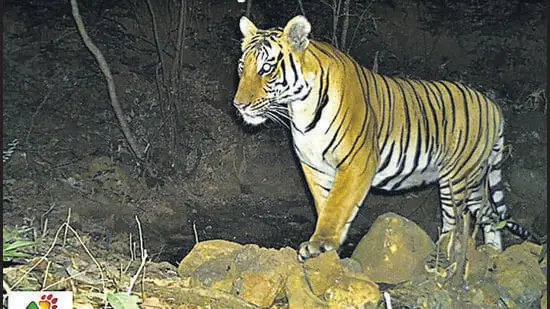
PUNE: In a shot in the arm for wildlife conservation efforts in western Maharashtra, the Radhanagari wildlife sanctuary, which is part of the Sahyadri tiger reserve (STR), has recorded the presence of two adult male tigers, taking the total tiger count in the sanctuary to nine, forest officials confirmed.
The two tigers, identified as STR-07 and STR-08, were recently recorded in March through regular forest patrols and camera trap evidence. Officials said that a detailed verification process, including an analysis of pugmarks, camera trap images and other scientific methods, confirmed the identity and gender of both the animals.
“These tigers have been consistently recorded through camera traps and field observations. Based on the available evidence, both STR-07 and STR-08 are adult males occupying distinct territories within the sanctuary,” a senior forest department official said.
The forest department has now intensified monitoring efforts to track the movement and behaviour of the two big cats. Preliminary findings suggest that both tigers are moving independently and have established separate territories, indicating a stable and expanding habitat. Officials added that continuous monitoring is being carried out to study the tigers’ movement patterns, use of water sources, and preferred habitats. “We are closely tracking their routes, prey base and habitat utilisation to better understand their ecology and ensure effective conservation planning,” the official said.
Wildlife experts have termed this development as a positive indicator of habitat connectivity and conservation success in the Sahyadri landscape. According to Rohan Bhate, honorary wildlife warden, the corridor connecting Sawantwadi–Dodamarg to Radhanagari plays a crucial role in facilitating tiger movement. “This stretch serves as an important wildlife corridor for tigers. It connects further to the Sahyadri tiger reserve, enabling northward dispersal of the species. Such connectivity is vital for maintaining genetic diversity and long-term survival,” Bhate said.
Moreover, the presence of nine tigers across the Sahyadri tiger reserve and adjoining Radhanagari landscape highlights the success of ongoing conservation efforts. Tushar Chavan, field director of the Sahyadri tiger reserve, emphasised the importance of sustained efforts in protecting these habitats. “The increasing number of tigers in the Sahyadri range is a testament to the effectiveness of conservation measures. Tigers like T7 (Raiba) and T8 (Sardar) have already demonstrated the importance of the Sahyadri-Konkan wildlife corridor. The addition of new individuals further strengthens this landscape,” Chavan said.
A new tiger has been recorded in the corridor area (Radhanagari) of the Sahyadri Tiger Reserve. The tiger has been named STR-10, “Ranoji.”
At present, this male tiger has established its presence and marked its territory within the Radhanagari Wildlife Sanctuary. With this addition, the total number of tigers in the Sahyadri landscape has now reached 10, of which 7 are males and 3 are females.
The existing tiger population in the region includes T1 Senapati, T2 Subhedar, T3 Baji, T4 Chanda, T5 Tara, T6 Hirakani, T7 Raiba, T8 Sardar, and T9 Shiledar. The addition of STR-07 and STR-08 reinforces the ecological significance of Radhanagari as an emerging tiger habitat.
Forest officials reiterated that conservation efforts, habitat protection, and community awareness will be key to sustaining this growth. With increasing tiger presence, authorities are also expected to focus on mitigating human-wildlife conflict while ensuring the safety of both local communities and wildlife. “This is an encouraging development, but it also comes with responsibility. We need to balance conservation with community safety through proactive measures,” an official said.