



Pune: The daily food habits of a community usually find a place within the festivals of the deity they worship. Dishes that sustain their work, express their values, or carry ritual significance are offered as “prasad” and take on a sacred character. What starts as an ordinary practice gathers meaning and becomes part of a shared tradition.
In 19th-century Maharashtra, much of the thinking around social change was framed through a religious lens. The spread of Western education, along with social reform movements that challenged established religious authority, led to a concerted effort to reinforce religious sentiment among the people. At the same time, the belief that religion and nation were inseparable led to a renewed emphasis on strengthening religious life through public festivals. As both reform and revival within religion gathered force, festivals like Ganesh Chaturthi and Hanuman Jayanti came to be seen as powerful instruments to bring people together and to nurture a sense of nationalism. By connecting religious figures and nationalist ideologies, religious nationalism was constructed and perpetuated within the framework of Hindu identity.
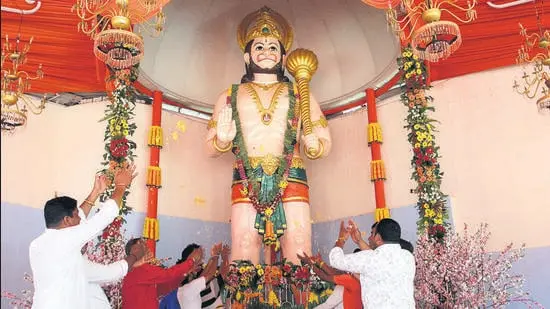
Hanuman Jayanti marks the birth of Hanuman, the revered god known for his strength, devotion, and unwavering loyalty to Lord Ram. The festival is observed on different dates across India, with devotees visiting temples, offering prayers, and reciting passages from religious scriptures. It is also closely associated with ideals of physical strength and discipline, reflected in ‘akhadas’, processions, and displays of martial training.
Pune was home to a large number of temples dedicated to Hanuman. These were small, modest shrines, often with curious names, and celebrated Hanuman Jayanti with great enthusiasm.
The Hanuman temple facing Shaniwar Wada was known as “Batatya Maruti”. The “Jilabya Maruti” was said to have acquired the name because beside this temple once stood a halwai’s shop. Each morning, as the confectioner prepared fresh jalebis, he would string the first batch into a garland and offer it to Hanuman.
The Hanuman Jayanti celebrations at the “Dulya Maruti” temple were particularly well known in the mid-19th century. The temple was built by Naro Anant Natu during the time of Peshwa Bajirao II. When Yashwantrao Holkar attacked and plundered Pune, Natu lost his property in the violence that followed.
Natu had also built the Someshwar temple. Both temples maintained “annachhatras” (free food halls), and shelters were provided for sadhus and gosavis. Many ascetics who would not eat food cooked by others prepared their own meals there. After the Natu family fell into financial distress, the “annachhatras” were shut down, and the shelters disappeared.
The Dulya Maruti temple was later renovated by a wealthy patron, Shrimati Rukhmabai, who reopened the “annachhatras”.
The priests of Bhikardas Maruti had migrated to Pune from Gujarat and Rajasthan. On Hanuman Jayanti, many worshippers offered “churma” (coarsely ground wheat, crushed and cooked with ghee and sugar), a dish popular in Rajasthan and northern parts of India, to the god with devotion.
At the temple on Hanuman Tekdi, devotees gathered at sunrise on Hanuman Jayanti to recite the “aartis” marking the moment of Hanuman’s birth. Newspapers carried invitations urging everyone to come for the “prasad”. The crowd was made up largely of college students, wrestlers, and people belonging to the Ramdasi Sampradaya, a 17th-century devotional and spiritual tradition founded by the Maharashtrian saint Samarth Ramdas Swami in 1644, centred on devotion to Lord Ram and Hanuman.
In front of the temple, spirited young men performed “suryanamaskars” and “dands” with remarkable energy. Informal competitions were often held and youngsters performing one hundred and one “suryanamaskars” were rewarded with extra “prasad”, most often jalebi. For many years, generous donors distributed “pedhas” and milk to all.
Chounde Maharaj, the Gandhian social reformer and a champion of the cow protection movement, visited all the Hanuman temples in the city on this day to collect alms according to the Ramdasi tradition.
In the early decades of the 20th century, some temples began to take out processions in the evening on Hanuman Jayanti, with the support of local gymnasiums. At the head of these processions were images of Chhatrapati Shivaji Maharaj and his brave commanders like Tanaji Malusare. “Lezim” troupes added rhythm and spectacle, while wrestlers in langots led from the front, embodying strength and discipline.
At the end of the procession, the temple would provide the wrestlers with a nourishing meal suited to their training. From the following day, wrestling bouts would commence, turning the celebration into a display of physical culture and community pride. Wrestlers from Satara, Kolhapur, Baramati, and Karad participated in these competitions.
The promotion of physical development formed an integral part of the reform movements of the 19th century. The Nationalist movement portrayed Hanuman as a central figure in the wrestling arena, embodying attributes such as strength, devotion, and asceticism, which were not only integral to the wrestlers’ practices and beliefs but also to the manufacturing of a nation that was “strong”, loyal, and determined. Certain Hindu nationalist organisations utilised the “akhada” as a site for both bodily reform and political indoctrination, where the imagery of Hanuman played a significant role in instilling a sense of identity and purpose among its members. The god was associated with qualities that were essential for the wrestlers, such as power, devotion, and celibacy, which were seen as vital for their discipline and practice. Many sports clubs and gymnasiums in Pune were dedicated to Hanuman.
Reports on Hanuman Jayanti published in Marathi newspapers after 1925 often mention members of Hindu nationalist groups presenting drills and displays of physical training during the celebrations.
Public lectures on themes such as the religious duties of Hindus, Hindu unity, and ways to strengthen Hindu society were organised on the day. The arrangements of community meals after lectures were typically made through collective effort, with residents coming together to cook and serve the food.
From 1912 onward, a certain Mr Kokate of Bombay published the “Hanuman Diary” each year in early January. Bound in cloth, the diary contained dated blank pages and included practical information such as postal rates and railway timetables, along with devotional material like Hanuman stotras and aartis.
Kokate marked Hanuman Jayanti each year with large public celebrations in Dadar and Pune. A temporary pavilion would be set up in an open ground, where wrestlers and gymnasium instructors were formally honoured. This was followed by a community meal open to all, featuring rice, “amti”, and jalebi.
“Lanka Dahan”, a film produced by the General Pictures Corporation Limited in 1930, was a regular feature of Hanuman Jayanti celebrations in Pune. By the standards of its time, it was unusually long, running to nine reels, or close to two hours.
The film was shown at Aryan Cinema every year till 1942. Nearby stood Mathura Bhavan, a sweet shop known for its jalebis. After the show, many viewers would make their way there, drawn by the promise of free hot milk and freshly made jalebis.
In the early hours, milk would be sold outside the Jogeshwari temple. On this day in particular, many milk vendors would distribute hot milk to wrestlers, as a mark of respect to Hanuman and his disciples, the wrestlers.
Milk, pedhas, and jalebi formed the preferred diet of wrestlers, and on Hanuman Jayanti, this combination appeared widely as “prasad”. The table and the temple came to mirror each other, each reinforcing the identity of the other.