



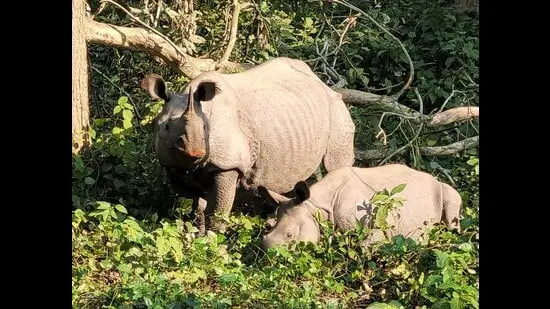
To break the cycle of in-breeding and widen their gene pool, Dudhwa Tiger Reserve (DTR) here is preparing to release six more one-horned rhinos from their fenced enclosure in the south Sonaripur range. The animals will be chosen from a pool of 16 candidates, but only after DNA tests from the Wildlife Institute of India (WII) confirm that no two selected rhinos share a bloodline, DTR authorities said on Sunday.
“Our focus is that the six rhinos, which are to be released into the open outside the fenced enclosure rhino rehabilitation area-1 (RRA-1), do not share the same gene pool and are genetically unrelated,” said Dr H Rajamohan, field director and chief conservator of forests, DTR.
He said they would ensure that the rhinos released outside RRA-1 are not from the same family (mother, father, or offspring) to maintain gene diversity. DNA (deoxyribonucleic acid) samples were collected through dung and sent to WII, Dehradun for analysis, Dr Rajamohan told HT. Female rhinos among the 16 that are pregnant will also be excluded, he added.
All six rhinos will be radio-collared before release to enable monitoring and behavioural study.
A core committee comprising Dr Rajamohan, the DFO south, DFO north, deputy director Dudhwa, Dr Mudit from WWF, Rohi Ravi, Dr Amit Sharma and rhino and elephant expert Dr KK Sharma is expected to meet after March 20 for the final selection.
With the release of six more rhinos, the total number in the open will reach 10. The forest department decided to release 10 rhinos into the open to counter in-breeding challenges and enable interaction with migratory rhinos, thereby strengthening the gene pool.
In the first phase, which began on November 29, 2024, four rhinos—one male and three females (Vijayshree, Nakul, Dipika and Riddhi)—were released with radio-collars. Special teams were deployed to monitor their movements and behaviour.
Dr Rajamohan said male rhino Nakul initially showed some hesitancy but soon adapted to his new surroundings, which have grasslands and wetlands similar to the fenced area. Rhino Riddhi recently gave birth to a calf in the open, underlining the success of the initiative. All four rhinos have shown normal behaviour and no conflict has been recorded.
Dudhwa’s grasslands, wetlands and safe shelters make it an ideal habitat for one-horned rhinos. In 1984, a 27 sq km area in the south Sonaripur range was developed as the first RRA-1 to reintroduce rhinos on their ancestral land, where the species had become extinct after once thriving in large numbers.
Project Rhino was launched in 1984 with just five rhinos from Assam and Nepal. The population grew to a point where a second RRA had to be established in Belrayan range at Bhadi Tal. DTR currently has 49 rhinos across RRA-1 and RRA-2.