



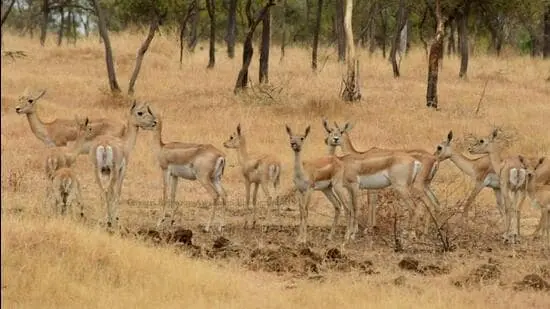
Beed district in Maharashtra’s Marathwada region—traditionally known as a dry, rain-shadow-prone area—may soon get a grassland safari, with the forest department initiating groundwork for the proposed project. Officials conducted a site visit on January 13 to assess potential locations and identify possible safari routes.
If approved, it will be the first grassland safari in the Marathwada region and fourth in Maharashtra, after two in Pune district and one in Solapur.
According to officials, around 3,000 hectares of contiguous grassland free from human settlements, villages, and encroachments have been identified in Ambejogai tehsil of Beed district.
Amol Garkal, district forest officer (DFO), Beed, said, “Officials visited the site and a development plan for the grassland safari will be prepared and submitted to the forest department’s head office in Nagpur soon.”
Highlighting the tourism prospects, Garkal said Ambejogai has many medical and agricultural colleges.
“Parli Vaijnath—one of the twelve Jyotirlingas—is located nearby, along with several religious sites. With religious and educational tourism already established, the proposed grassland safari is expected to attract citizens in the region,” he said.
Speaking about biodiversity, the DFO noted that the continuous grassland supports a healthy population of both herbivores and carnivores. “Wildlife recorded in the area includes leopard, jackal, chinkara and other grassland-dependent species. We are also in the process of relocating 35 blackbucks received from Solapur district,” Garkal said.
Forest officials said the proposed safari in Beed will be developed with conservation as the primary focus, while also providing sustainable livelihood opportunities for local communities through eco-tourism.
Eco-tourism drive
A grassland safari is a controlled eco-tourism initiative designed to showcase open grassland ecosystems, which are among the most threatened habitats in India. Unlike forest safaris, grassland safaris focus on wide-open landscapes dominated by grasses and sparse tree cover. These ecosystems are crucial for species such as blackbucks, chinkaras, wolves, foxes, bustards, and migratory birds.