



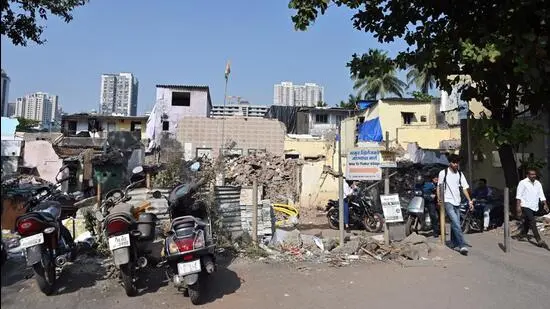
MUMBAI: After lying dormant in the city’s archives for almost half a century, a 120-foot DP Road has finally moved from yellowing pages onto Mumbai’s chaotic streets. Ground zero is a 250-metre stretch in Kandivali east, and the battle has been monumental. It involves a booming township, warring politics, disparate land claims, bureaucratic hurdles, a court case – and Singh Estate, a colony of 310 slum families who stand in its way.
For more than a decade, when battle lines were first drawn, the residents of Singh Estate resisted every effort to treat them as casualties of development. Squatting on 250m of land earmarked for the DP Road, they were labelled as slum dwellers but had grown into a colony, with some homes as large as 1,000 square feet. Many had backyards, some even had parking space.
The residents were not resisting rehabilitation per se; they were demanding what they felt was just and equitable rehabilitation in exchange for making way for the new road.
Their strongest weapon was an imaginary line that divided two assembly constituencies. Singh Estate found itself on the right side of this line, bringing the residents political support through a bitter battle that went all the way to the chief minister.
How did it all finally play out?
Far-sighted plan
The 120-foot-wide DP Road was first included in Mumbai’s Development Plan (DP) in 1967 as an alternative to the Western Express Highway. With a population boom projected in the western suburbs, the road was repeated in the DPs of 1991 and 2014 – applicable till 2034. It is 5.2km long, from Dahisar to Goregaon, but only a fraction – 580m – falls in Kandivali
Over time, Lokhandwala Township in Kandivali east, built on 200 acres in the 1990s, grew and expanded. The amenity-rich, family-oriented, gated township flourished into a mini suburb of 30,000 residents, housed in 53 buildings. The neighbourhood is still growing, as is its aspirational quotient.
Santy Shetty, who moved to Lokhandwala in 2011 and started a local collective called We All Connect (wAc), said, “To get to the highway, we depend almost entirely on Akurli Road. This 1.5-km stretch is perpetually clogged with traffic. Developing the DP Road would change everything for us.”
From the Lokhandwala-Akurli Road junction, the new road would extend to SN Singh Road (via Thakur Village), and proceed onward to the highway.
Featuring among the election promises of Atul Bhatkalkar, elected BJP MLA from Kandivali east in 2014, marked the first concerted effort to make the DP Road a reality.
First, the BMC had to acquire 580m of land: Part of the road was marked as a private forest and had to be de-reserved; 245m lay within the Mahindra & Mahindra factory compound; the next 250m was owned by M/s Bredco, a real estate company; the final 85m stretch was under MHADA. It took six years but the BMC eventually acquired the land by 2020.
The most challenging task was the 250-m stretch that houses Singh Estate, which falls on the former Bredco land. The BMC initially offered alternative accommodation in Mahul, near Chembur, and in Kandivali. The alternative homes were 225sq ft, for project affected persons (PAPs).
Mahul had been selected as the government has 3,800 flats for PAPs there, with no takers. But the residents of Singh Estate said Mahul was too far and the area, housing refineries and chemical factories, was highly polluted.
310 homes vs 250m road
Working in favour of Singh Estate was an imaginary line dividing two assembly constituencies. While Lokhandwala Township falls under the Kandivali east constituency, Singh Estate comes under the Magathane constituency. On the Lokhandwala side was BJP MLA Atul Bhatkalkar pushing hard for the new DP Road, and on the other was Shiv Sena MLA Prakash Surve, batting for Singh Estate.
That’s when the war really began.
The BMC served the first batch of eviction notices to Singh Estate in 2017, when residents were told to submit documents. Only 100 residents responded. Such was their opposition, that when the final notice was served in November 2020, only six residents responded.
“The BMC was offering rehabilitation in Mahul, which the residents were opposed to,” said MLA Surve. “And why wouldn’t they be? At the opposite end of the city, no one wants to go there due to the pollution.”
The BMC then offered monetary compensation according to Ready Reckoner rates, with a cap of ₹50 lakh. This too did not gain traction with Singh Estate.
Final push
Covid brought some respite from traffic for the residents of Lokhandwala Township, but when the second wave subsided, traffic on Akurli Road returned with a vengeance. “When offices started calling people back, traffic went from bad to worse. It took 30-40 minutes to navigate 1.5km, merely to get to the highway,” said Santy.
By now, others had joined the fray. Shishir Shetty, a Lokhandwala resident since 1996 and co-founder of the Lokhandwala Residents’ Association (LRA), said, “Our first campaign was back in 2016, which led to some traffic rules being changed. This made some difference,” said Shishir Shetty, backed by Bhatkalkar.
Also claiming credit is Nitin Jha, a Lokhandwala resident who runs a non-profit, Soham Foundation. “By 2022, the BMC had built the road on Mahindra land, but it ended behind the Singh Estate wall,” said Jha, currently affiliated to the Shiv Sena. “It was my andolan that led to the wall being demolished, giving two-wheelers an alternative.”
The big push came in 2022, when Bhatkalkar raised the issue of the DP Road during the monsoon session of the state legislature. The project was bumped up to a ‘vital infrastructure project’. But little changed – until June 2023.
Both the warring MLAs, Bhatkalkar and Surve, were summoned for a meeting at the Sahyadri Guest House, chaired by then deputy chief minister Devendra Fadnavis, along with civic officials. When they walked out, instead of a road, an alternative plan, to build an elevated bridge – to save 310 slum homes – was on the cards!
The idea didn’t gain traction. Bhatkalkar thought it needless; former corporator Surekha Patil (BJP) said it was another ploy to delay the road; and civic officials felt and Surve believed it was futile.
Nonetheless, a feasibility study was ordered and three bridge styles were proposed: a cable-stayed bridge, a bow-string bridge with a steel girder, and a bow-string bridge with a stainless steel girder. The cost ranged between ₹500 crore to ₹950 crore, and the plan would take almost 3 years to execute. Most importantly, all options would require the slums to be removed.
Logic prevailed and the BMC ruled in favour of the DP Road.
Then another scheme was briefly considered. At another meeting, in March 2024, chaired by then chief minister Eknath Shinde, realignment of the road was discussed.
At this point, Shishir Shetty, backed by Bhatkalkar, filed a public interest litigation (PIL) in the Bombay High Court.
“Is it fair,” asked Shetty, through the PIL, “that after completion of 80% of the road, acquiring land from multiple parties, building most of it, and spending years and crores, that the State of Maharashtra can seek a realignment of the road at the cost of public money?”
The court instructed the municipal commissioner to decide on realignment and, in October 2024, civic chief Bhushan Gagrani decided against the proposed realignment. Most importantly for the residents of Singh Estate, he said, “eligible PAPs would be accommodated as per government policy in the vicinity”.
After a year’s setback, the BMC went back to searching for PAP homes.
“From refusing to share documents to moving out of their homes themselves, the Singh Estate residents have begrudgingly accepted rehabilitation,” said a BMC official from R South ward’s maintenance department, overseeing the issue since 2023. “We offered options of 400-sq ft homes, provided they paid for the additional space, but they refused. We are allotting homes as and when we get PAP homes in the vicinity.”
In June 2025, the first 47 residents were allotted flats in Bitcon Elysium building in Kandivali east. A lottery for another 120 homes was held on December 15, and, soon, 38 homes will be allotted.
For the residents of Singh Estate, what’s left is a sense of betrayal. What began as a fight to the finish did not tilt in their favour. “None of the politicians were ever really on our side, they only pretend to be. After a point, we couldn’t keep up the struggle,” said Suresh Arjunwade, 65.
With BMC elections in January, the BMC is moving quickly to rehabilitate the remaining eligible PAPs. And, even though the new road can take shape only after the last batch of PAPs is resettled, the civic administration has promised to build the new DP Road early next year.
But there’s scepticism already. With the new road potentially merging in Goregaon with the Goregaon-Mulund Link Road (GMLR), more than 1,000 slum encroachments stand in its way.
The road, it appears, is destined to repeat its tangled story.