



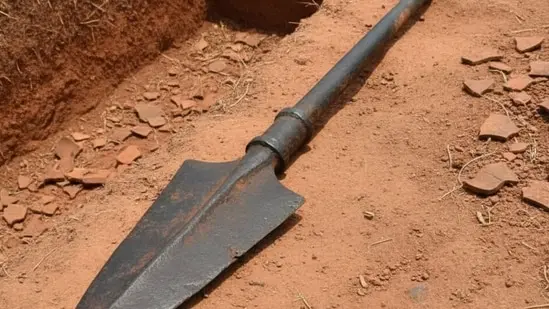
Archaeologists in Tamil Nadu have discovered an 8-foot-long iron spear at Thirumalapuram, around 80km from Sivagalai in Tuticorin, marking the longest iron implement from the Iron Age found in India so far.
The spear may have been used by ancient warriors to protect cattle and wealth, or it could have served as a ceremonial object smelted for a prominent individual and buried alongside them.
The excavation also revealed a second, shorter spear measuring 6.5ft, placed in an ‘X’ formation beside an urn that contained gold objects. The longer spear is slightly rounded at one end, suggesting it was designed for ease of handling. Such burial sites have previously yielded other weapon-grade objects, including daggers, swords, knives, and spears, indicating the presence of skilled metallurgical practices, according to a report by The Times of India (TOI).
Also read| Tamil Nadu governor unfurls national flag in Chennai, CM Stalin presents gallantry awards
Experts note that the preservation of iron at this site is unusually good compared with other regions of India, where moist soils often cause rapid corrosion.
The length and design of the spear reportedly suggest that it may have been a customised ceremonial piece, possibly reflecting the social status of the person buried in the urn.
The discovery highlights the advanced iron-smelting techniques in Tamil Nadu, which existed between 3000 BCE and 2500 BCE.
Smelting iron during this period required extremely high temperatures, ranging from 1,200 degrees Celsius to 1,500 degrees Celsius. Archaeologists emphasise the need for further studies to trace the evolution of iron technology in the region and to gain wider recognition for these findings at a global level.
In the coming years, the Tamil Nadu state department of archaeology, in collaboration with the department of metallurgy at IIT Gandhinagar, plans to conduct a comprehensive study of various Iron Age sites across the state to better understand the technological and cultural significance of these discoveries.