



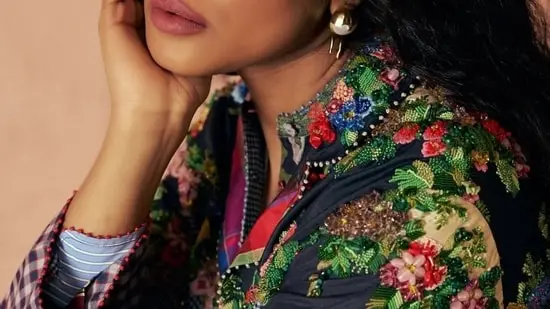
In the special Valentine’s edition of HT Showstoppers, we look at Aneeth Arora, the textile artist and dressmaker behind péro.
While the world celebrates romance with roses and ribbons, Aneeth has spent the last 16 years writing a continuous love letter to India’s craft heritage.
Her brand is a labour of love, one where every stitch is a heartbeat and every button is a promise of being "handmade with love."
For Aneeth, the romance didn't start on a runway, but in the classrooms of National Institute of Fashion Technology (NIFT), Mumbai and later National Institute of Design (NID), Ahmedabad. She recalls a pivotal moment during her final collection at NIFT, when she noticed everyone sourcing from the same textile markets. This lack of originality sparked a desire to dig deeper. "That is when I felt I needed to learn more about textiles," she explains, "and I decided to pursue textiles at NID."
It was at NID that her "eureka moment" occurred, fuelled by the sight of a single Kutchi blouse made by a mother for her daughter in Bhuj. The piece was a tapestry of community: embroidery from one group, Bandhani from another, finished with buttons and tassels by a mother’s hand. "I saw the piece and the extent of the power of community where they come together to make something unique," Aneeth recalls. "So that was my eureka moment - if I were to ever start a clothing label, the philosophy will be handmade."
When péro launched in 2009, it wasn't about making a loud statement, but about a quiet, steadfast conviction. Aneeth wanted to bridge the gap between high-fashion "occasion wear" and the effortless confidence she saw in village communities. "It’s not always about standing out," she muses, "it could be jelling in but yet feeling special with what you’re doing."
Coming from Udaipur, she was often told that fashion was reserved for the "perfect" bodies of models—a notion she set out to dismantle. The result was comfort clothing meant for everyone. Even the name, péro, which means "to wear" in Marwari, was a nod to her roots and a rejection of fashion’s elitism. "From the get-go," she says, "it means to wear... it tells you that it’s a wearable brand."
This devotion extends to the very fibers of the garments. Unlike designers who buy existing fabrics, Aneeth creates her own canvas. "I decided I would make my textile and not buy the existing ones," she says. "It’s almost like an artist who can weave their own canvas and paint on it. Wholesome feeling." This meticulous process is what allows the brand to stay true to its "Handmade with Love" tag, a sentiment that Aneeth says comes naturally to her artisans. "If you do it with love, it will show," she adds simply.
Recently, this love story expanded into the home. After 16 years of focusing on dressmaking, the COVID-19 lockdown allowed Aneeth to finally curate péro Home, a line she describes as the "true essence of slow living." Using textile remnants she had saved since her very first day, she created a range that covers the pillars of "eat, sleep, live, clean, and breathe."
Despite the global success of péro, Aneeth remains a figure in the shadows, preferring the spotlight to fall on the hands that create the magic. Drawing inspiration from "creative artists in disguise" like Maison Margiela, she views herself as a narrator rather than a star. "I could be a voice of story narration to the people. I needn’t be the face of the brand," she insists. "I strongly believe it’s not only me and I can't take the full credit for it."
As for the future? Her love for her muse, India is inexhaustible. "If I were to write a love letter, it cannot be for a particular textile or a weave. It will be for India," she says with the enthusiasm of a child. "Often asked, what if one day you run out of inspiration? I will never. It’s coming from India and India never stops."