



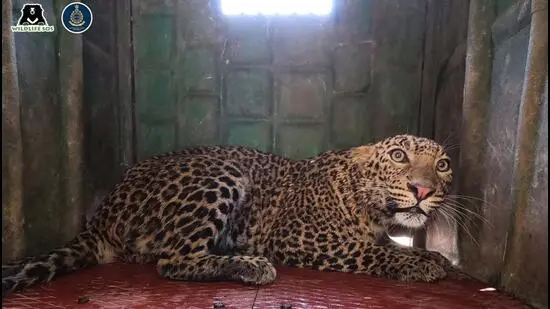
PUNE: A sharp rise in human-leopard conflict from October to December 2025 in Junnar, Shirur and the adjoining areas has prompted the Pune forest department to launch an extensive leopard (population) census across non-protected areas of the Junnar forest division. This is the first time such a large-scale assessment is being conducted outside protected forest areas in the region.
A senior forest official said, “The growing conflict situation has made it necessary to conduct a scientific population assessment. An accurate estimate of leopard numbers and their spatial distribution will help the department frame effective conflict mitigation strategies and guide future policy decisions.”
Started in January and expected to be completed by May this year, the exercise spans all seven forest ranges under the division namely Manchar, Junnar, Otur, Shirur, Ghodegaon, Khed and Chakan. Together, these ranges form a complex landscape of forest patches, agricultural fields, sugarcane belts, villages and rapidly urbanising zones. According to officials, such fragmented habitats often support higher leopard presence due to the availability of prey and cover while simultaneously increasing the possibility of leopard-human encounters. The population estimation is being carried out in consultation with Mumbai-based Wildlife Conservation Society (WCS), which is providing technical expertise and will undertake data analysis.
Smita Rajhans, assistant conservator of forests, Junnar forest division, said that the census was initiated following two fatal leopard attacks in Pimparkhed village. Shivanya Bombe and Rohan Bombe were killed in separate incidents on October 12 and November 2, respectively. “After these incidents, it was decided that a detailed leopard population census should be undertaken across all ranges of the Junnar forest division. The WCS was consulted, and the study is now being implemented systematically using scientifically accepted methods,” she said.
As part of the methodology, camera traps are being installed across multiple plots identified in each forest range in a bid to capture images of leopards over a fixed period of time. Individual animals will be identified based on their unique spot patterns, allowing researchers to estimate population density and movement across landscapes. The endeavour was kicked off with a pilot study in the Manchar range that helped fine-tune the placement of cameras as well as field protocols.
The first phase of data collection began simultaneously in the Junnar, Otur and Shirur forest ranges from February 5. Each range requires approximately one month of continuous monitoring to complete the estimation process after which, cameras are shifted to the next range. In the subsequent phase, the remaining ranges—Ghodegaon, Khed and Chakan—will be covered. The data collected from all ranges will be analysed by the WCS and the forest department expects to receive the final population estimates by May.
Officials emphasised that the census is critical for managing the growing interface between humans and leopards in the region. Scientific data on leopard numbers and their distribution will help identify conflict-prone villages, seasonal movement patterns and high-risk zones, enabling targeted interventions rather than reactive responses. This includes planning awareness programmes, strengthening livestock protection measures, improving response protocols during emergencies, and optimising deployment of frontline forest staff. The findings are also expected to guide long-term conservation planning by providing insights into how leopards are adapting to human-dominated landscapes; a trend increasingly observed across Maharashtra. Forest officials said the exercise could serve as a model for similar population assessments in other forest divisions facing rising human-wildlife conflict, ensuring that future decisions are based on reliable data rather than on assumptions.
The last systematic assessment of leopard numbers in the region was conducted in 2021 by the Wildlife Institute of India as part of a four-year research project. That study, however, was limited to Junnar tehsil and estimated the presence of six to seven leopards per 100 square kilometres, prompting the need for a wider and more updated assessment across the entire forest division.