



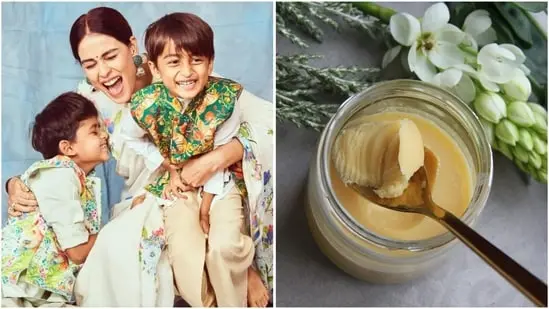
What children eat in their early years often shapes their relationship with food for life. As conversations around traditional fats like ghee continue to evolve, many parents are questioning how much is too much. In a January 2 podcast with Soha Ali Khan on her YouTube channel, Genelia D’Souza reflected on her approach to nutrition, explaining why ghee played only a limited role in her diet and how health considerations influenced her choices for her children. (Also read: Genelia D’Souza shares why she gave up meat in 2017 and turned vegan during the pandemic: ‘My first step was selfish…’ )
Why Genelia D’Souza limits ghee in her diet
Sharing her personal experience, Genelia said, “Ghee was never a very big part of my diet. I’ve always been more conscious because cholesterol issues run in my family. Whether it was non-vegetarian food or anything else, it was always on my mind, I didn’t want to go overboard.”
She added that while she did enjoy ghee and butter occasionally, it was always in very small quantities. “I enjoyed a little bit of ghee and butter, but only in tiny portions. So when I eventually gave it up, it wasn’t a big deal,” she explained, acknowledging its appeal. “I know it’s very tasty and it smells amazing.”
Weighing in on the growing conversation around ghee being labelled a superfood, Genelia maintained a balanced stance. She said that while there is plenty of information around the topic and experts are better placed to judge whether ghee truly qualifies as a superfood, she doesn’t see limiting it as harmful. Responding to questions about not giving ghee to her children, she clarified that she isn’t “blocking their arteries” and believes moderation is key.
What Genelia believe about ghee for children
She also highlighted the importance of mindful eating habits from a young age. “We start building habits early. You can’t keep feeding children excessive amounts of certain foods and then expect them to suddenly not be overweight and head to the gym later in life. It has to make sense.”
Genelia stressed that the real concern is excess, not the ingredient itself. She explained that the problem arises when ghee is consumed in very large quantities, something she often sees people doing with generous spoonfuls. She clarified that she isn’t labelling ghee as good or bad. Speaking about her own choices, Genelia added that since she follows a plant-based lifestyle, ghee doesn’t fit into her diet, but she is completely fine with others consuming it if it works for them.
She also shared a plant-based alternative she regularly includes in her meals. According to Genelia, while many believe ghee supports lubrication or bone health, similar benefits can be achieved through seeds like til. She mentioned that her rotis are always made with black or white til, highlighting it as a staple source of healthy fats in her diet.
What nutritionist say about giving ghee to children
Soha and Genelia were also joined by nutritionist Kinita Patel on the podcast, where she shared a firm yet balanced take on ghee in children’s diets. “I refuse to give any one food item a throne and a crown. There is no single food that is a superfood,” Kinita said, adding that ghee on its own should not be glorified. “Ghee can have benefits when combined with other elements, but by itself, it is not a superfood. It doesn’t work that way,” she explained, noting that small amounts of fats like ghee or virgin coconut oil may help manage sugar spikes when used mindfully.
She cautioned strongly against overconsumption. “Ghee on paratha, ghee on khichdi, ghee at every meal is not okay. There has to be a limit,” Kinita said. Addressing plant-based diets, she reassured listeners, “If you’re vegan, you’re not losing out on anything. Healthy fats can come from nuts, seeds, virgin coconut oil, or even a simple coconut chutney.” She concluded by emphasising balance over trends, saying, “You can’t just crown ghee and dismiss everything else. The substitute has to be right.”
Note to readers: This article is for informational purposes only and not a substitute for professional medical advice. Always seek the advice of your doctor with any questions about a medical condition.
This report is based on user-generated content from social media. HT.com has not independently verified the claims and does not endorse them.