



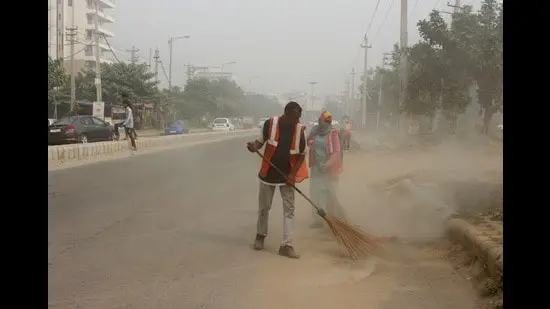
Majority of the road network proposed to be redeveloped this year to curb dust pollution in Gurugram will comprise internal sector roads, according to the city’s clean air action plan prepared under the framework of the Commission for Air Quality Management.
The plan, assessed by HT, identified around 726 km of road network in debilitating condition due to loose dust, bitumen damage and potholes, making them unsafe for commuters. Of this, around 554 km of roads proposed for repair and recarpeting have a right-of-way width of less than 10 metres and primarily serve internal connectivity for residential societies and villages.
Redevelopment has also been planned for about 83 km of roads with a right of way between 10 and 15 metres, which function as two-lane arterial or link roads. All roads with a right of way of less than 10 metres fall under the jurisdiction of the Municipal Corporation of Gurugram. Among roads with a width of 10 to 15 metres, around 49km are under the MCG, while about 20km and 14km fall under the Public Works Department and the Haryana Shehri Vikas Pradhikaran, respectively.
Around ₹430 crore is estimated to be spent on phased repair works of identified internal sector roads. In addition, civic agencies are expected to invest another ₹280 crore by 2028 to redevelop other identified road stretches with a right of way width between 10 and 30 metres.
The plan has also earmarked roads under the Gurugram Metropolitan Development Authority that are in poor condition. These include around 30km of roads with a right of way between 15 and 20 metres and about 19km with a width of more than 60 metres, serving as state highways or six-lane corridors.
The National Highway Authority of India has been tasked with maintaining 18km of its 36km road network in Gurugram identified under the plan. This includes around 12km with a right of way greater than 60 metres and 6km between 45 and 60 metres. The plan states that all NHAI roads have been linked to the road asset management system to ensure safety, efficiency and cost effectiveness.
Earlier, through the Sanjaya App managed by the Ministry of Road Transport and Highways, around 32 accident blackspots were identified in the district, which together accounted for 50 fatalities in 2025.
Of the 396km of sector and internal roads to be redeveloped this year, civic agencies have been assigned monthly targets, ranging from 10.4km in January and 15.3km in March to 1.07km in July, before peaking at 108km each in October, November and December.
“Realistic targets based on seasonal changes have been set to make the city clean, dust-free and safer for commuters to travel. The plan acknowledges that rebuilding activities will slow during monsoon season and will again pick up once the dry weather spell resurfaces,” said a senior MCG official, requesting anonymity.