



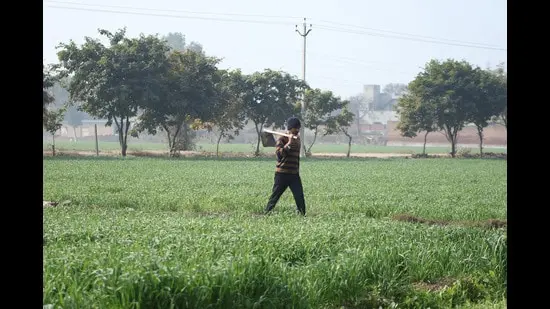
Agricultural experts and farmer organisations have said Punjab once again found no mention in the Union budget 2026-27, with key demands such as a legal guarantee for minimum support price (MSP), crop diversification and debt relief remaining unaddressed.
Economist RS Ghuman said he found “nothing in the budget for Punjab”, despite the state facing an acute agrarian and financial crisis.
“There is nothing about crop diversification, debt relief or any kind of special package for Punjab, which was widely expected,” Ghuman said.
He pointed out that while the allocation for rural development has increased marginally from ₹2.12 lakh crore in the revised estimate for the current financial year to ₹2.73 lakh crore for 2026-27 — about 5.11% of the total budget — Punjab has not been specifically mentioned.
“North-eastern, southern and hill states find a mention, but not the border state Punjab,” he said, adding that the fertiliser subsidy has been reduced from ₹1.86 lakh crore to ₹1.71 lakh crore.
Ghuman also flagged a sharp cut in the Mahatma Gandhi National Rural Employment Guarantee Act (MGNREGA) allocation, which has been reduced to ₹33,000 crore for 2026-27 from ₹88,000 crore this year. “Even if ₹33,000 crore represents 60% of the mandated allocation under the new scheme, the total outlay would be around ₹42,000 crore, which is less than half of the current year’s spending,” he said.
Rice millers have also expressed disappointment over the absence of measures to boost basmati rice exports. Ranjit Singh Jossan, vice-president of the Rice Millers’ Association, said the budget failed to address key issues such as financial support for overseas marketing, relief from high logistics costs and direct export assistance.
“If the Centre and the state work together to address these issues, Punjab’s rice industry can emerge stronger, not only nationally but also in global markets,” Jossan said, adding that a greater focus on agri-infrastructure, food processing and export promotion could have created new opportunities for farmers, millers and exporters.
Farmer unions were more critical. Jagmohan Singh, general secretary of the Bharatiya Kisan Union (Dakaunda) and a constituent of the Sanyukt Kisan Morcha (SKM), said agriculture had been “completely ignored”.
“Punjab, Haryana and western Uttar Pradesh are the food bowl of the country, yet there is no mention of the crops grown here,” he said. According to him, the allocation for agriculture and allied sectors stands at ₹8,766 crore, which is “a meagre 3% and deplorable”.
“There is no mention of a legal guarantee for MSP on all crops, which SKM has been demanding,” Dakaunda added, while noting that the budget reiterated earlier allocations of ₹1,000 crore for the pulses mission, ₹500 crore for the vegetable mission and ₹500 crore for the cotton technology mission.
Rajya Sabha MP Vikramjit Sahney also expressed disappointment over the absence of a special economic or border-area package for Punjab, despite the state’s high debt burden and strategic location.
“Budget 2026 has several forward-looking announcements, but Punjab is completely ignored,” Sahney said. He added that though Punjab is at the forefront of the national challenge of crop diversification, the budget offers no concrete financial or policy push in this direction, barring a broad mention of AI-driven farmer intelligence systems.