



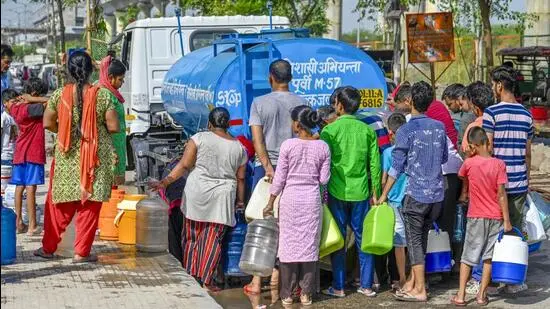
Of the 15,600km water supply network in the Capital, nearly 18% is more than three decades old and in need for replacement, according to a report by the Delhi Jal Board (DJB). Ageing pipes are prone to cracks and leaks that can raise the likelihood of water contamination. Concerns over water supplies in cities are in focus after contaminated water in Madhya Pradesh’s Indore killed at least 10 people.
“There is 2,800km (17.94%) of network which is more than 30 years old,” the report, accessed by HT, said. It further noted that at least half of the water (50-52%) is non-revenue water (NRW), unaccounted for due to non-metered connections, punctured pipes, thefts and leakages. NRW can cause significant financial and resource loss for utilities.
DJB plans to undertake study of the entire supply network through Japan International Cooperation Agency (JICA) or similar technical experts to revamp the supply network, the report states.
This has significant implications for Delhi. The DJB currently operates nine water treatment plants across the city that supply around 1,000 million gallons water per day (MGD).
According to DJB’s water quality surveillance reports from December 22 and 26, of the 7,129 samples of drinking water from various parts of the city, samples from 100 locations were found to be “unsatisfactory”.
Some of the samples were taken from underground reservoirs and booster pumping stations as well. The localities where samples failed included DDA flats in Mansarovar Park, Puran Nagar Palam, several samples in Sector 13 Dwarka, Bhagat Enclave in Uttam Nagar, booster station at Siraspur, Gali 8 Mohammadpur, Uttam Nagar’s Vijay Vihar and Kiran Garden, Vijay Colony in Burari, parts of Jonapur, Ghitorni among other places. DJB officials claimed that corrective action was taken after the samples failed.
The water utility relies on testing the residual chlorine levels in the supply water samples to test their suitability, officials said.
Speaking to HT, Residents’ Welfare Association (RWAs) in south, central, old, and north Delhi said water contamination from sewage and drainage-related issues remain an everyday reality for them, despite multiple complaints to local authorities.
“The water supply lines run next to sewage lines. Moreover, people use motor pumps during the supply hours. Broken old pipes and widespread use of pumps makes the initial 10-15 minutes of supply water smelly and contaminated,” Ashok Bhasin, president of the North Delhi RWA said, adding, “ Supply lines in areas like Old Delhi, Ghantaghar, Sabzi Mandi, Malkaganj, and Chandrawal are around 40-50 years old.”
In response, a senior DJB official said that a large-scale replacement programme of water supply lines is being undertaken in areas such as Yojana Vihar, Jagriti Enclave, Shanti Mohalla, Jhilmil Industrial Area, Dilshad Garden, Gandhi Nagar, and IP Extension.
“The government has also cleared Chandrawal catchment area improvement project under which 1,000km of new water pipelines will be laid, reducing leakages and contamination issues,” the official added.
Over the last one year, the Delhi High Court and National Green Tribunal (NGT) have pulled up the DJB on several instances of drinking water supply contaminated by sewage, including Yojana Vihar, Anand Vihar and Janakpuri, where old leaking supply lines were leading to contamination.
Last year, after residents of A block in Janakpuri complained of muddy water supply in their area, the Central Pollution Control Board (CPCB) in September found “very high bacterial contamination”, with faecal coliform levels in some houses reaching 16 million units — a parameter that should be zero in potable water.
The NGT had criticised DJB for failing to act on it, following which the process to replace the supply line started.
Activists also flagged loopholes in the water testing mechanism of DJB. Of its 25 water testing labs in the city, only two – Haiderpur and Wazirabad – appear on the accreditation list of National Accreditation Board for Testing and Calibration Laboratories (NABL), Yamuna activist Pankaj Singh has alleged. He wrote a letter to the DJB’s CEO in this regard on December 29.
Atul Goel, president of United Residents Joint Action (URJA), an umbrella organisation of around 2,500 RWAs, said the entire Delhi has sanitation and water contamination-related issues, but the concern is more prominent in areas like Karol Bagh, Rajinder Nagar, Chandni Chowk, Model Town and Shakti Nagar.
“Initial water supply is almost always contaminated. During idle hours, the contaminated water enters the supply network. There is an urgent need to replace the old pipelines and plug the sites where people have illegally punctured them,” he added.
URJA on Saturday posted on X: “Another Indore in making at central Delhi Karol Bagh, condition of service lane remains the same even after repeated complaints to elected representatives and authority. Sewerage and drainage and foul smelling water.”
BS Vohra, RWA president of east Delhi, said though water supply in most of the area is clean since it is being supplied directly from Sonia Vihar, but around six days in a month, the water emanates a foul smell and is muddy. On those days, residents have to survive on packaged drinking water, he added.
Complaining of foul-smelling and unclean water supply, Sanjay Anand, 58, general secretary of the Greater Kailash RWA, said the issue appeared to have become worse.
“I spend ₹1,000 for service every three months. Around seven years ago, we would get the water purifier checked once every six months, but now every two-three months we are forced to get it checked,” he said. “On every service visit, we think the issue is because of the purifier’s filter, but the staff tells us it is because of the polluted water.”
DJB spokesperson did not respond to HT’s request for a comment on the matter.
Diwan Singh, an environmental activist who has been closely working with water sector in Delhi said the issue of old water supply lines leading to water contamination has become a part of life for large population in Delhi and an immediate audit of the supply line system should be carried out.
“DJB should have a system of replacing the pipelines before they reach their 30-year life period. An independent mechanism needs to be developed to detect faults as it is a matter of public health,” Singh said.
Besides, another factor leading to contamination is the unauthorised connections from main supply lines. “These puncturing of supply lines also add to contamination risk. DJB needs to study and liberalise its process of taking formal connection. We have also suffered due to water contamination in Mundka for years. The initial part of supply is contaminated and people let water run for 10-20 minutes. It is essentially diluting the contamination and using water purifiers for rest,” he added.