



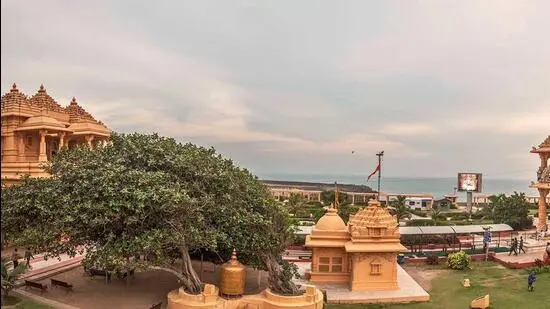
Situated in the historically fertile region of Saurashtra (Kathiwar), Somnath, also known as Prabhas Patan was associated with Veraval, one of the important ports among the several that dot the Gujarat coast. Like Prayagraj (also known as Allahabad), Somnath or Prabhas Patan is located at the confluence of three rivers - Hiran, Kapila and the mythical Saraswati.
Archaeological excavations carried out in 1955-57, and 1975-77, and in the early 1990s at nearby Datrana village take its human history to the pre-Harappan period (more than 2,800 years BC). The later periods are evidenced by Lustrous Red Ware, a Gujarat specialty, iron artifacts as well as Northern Black Polished Ware which also shows linkages with the Ganga valley. Maritime trade links are indicated by the discovery of amphorae sherds from the Hellenistic world.
Therefore, Somnatha on the western coast was an active place where trade from the sea snaked up through Junagadh and joined the land-based trade routes going up to present-day Kutch and then into Sindh and further northwards. Though Prabhas-Patan is mentioned as a famous tirtha in the Vanaparvan of Mahabharat, there is no reference to a temple at Somnath.
The myth of Soma and his wives and curse by the father of one of them has been described as a way to link the deity at Somnath with the holy site of Prabhas. In the Mahabharat, there also is a reference to Prabhas as the meeting ground for Krishna and Arjuna, thus it could have been an early Vaishnavite pilgrim site before it acquired the clearly Shaivite identity of being one of the 12 sites where the jyoti linga fell.
The Buddhist presence was fairly substantive in the region post Ashoka (3rd century BC) and all the way up to the 7th century CE. Buddhism embraced trade and commerce and therefore we find rock-cut monastic cum trader lodgings throughout the western coast such as in nearby Junagadh and Girnar as well as those on inland trade routes such as the Karla caves near Lonavala. In fact, an inscription dated 120 CE, in one of the main Chaitya caves records the gifting of eight wives to the Brahmins at Prabhas.
The Somnath temple
The first inscriptional evidence of a temple at Somnath comes from a Chedi inscription from either late 10th or early 11th century tells us that Lakshmanraja, the Chedi ruler, “on his warlike expeditions he is said to have reached the shores of the western ocean, where he worshipped Siva at the famous temple of Somesvara or Somanath in Gujarat”. However, the Chalukya or Solanki dynasty is generally considered to be the builders of the temple, or at least, renovators of an existing temple. A contemporary account by Al Biruni, Mahmud’s chronicler supports this possibility as Biruni clearly writes that the temple of Somanatha was built 100 years before Mahmud sacked it.
This is quite possible as the adjacent site of Prabhas was considered sacred. Hemachandra (1088 – 1172 CE), the great Shwetambar Jain poet, theologian and courtier of the Chalukyan king Jayasimha Siddharaja who was born decades after Mahmud of Ghazni’s raid in 1026 CE, writes about constant battling between rival chieftains in Saurashtra who harassed pilgrims and obstructed them from going to Prabhas, where they would be charged pilgrim tax. For the rival chieftains these pilgrims were a source of revenue.
The Chalukyan kings beginning with their dynasty’s founder Mularaja (941-996 CE) pacified local indigenous dynasties such as the Chavdas, and Abhiras and acquired suzerainty over the region. The Chalukyans promoted trade and commerce and it was these riches that attracted Mahmud who wanted to establish himself as an ardent follower of Islam and project himself as a devout Sunni.
In January 1026, after a siege of Prabhas-Somnath and the fort that protected it (on three other sides was the sea), Mahmud took over the town and shrine from the fort-commander Mandalika and his largely Turkic army (there were Indian elements in it as well) indulged in plunder and loot. However, according to Chalukyan records and other Sanskrit texts, it is clear that the Chalukyan kingdom didn’t take long to recover from it.
Somanath: Facts Vs Symbolism
The accounts in Persian-Turko chronicles such as those of Al-Biruni, Al Utbi, Bayhaqi, Firdausi and Gardizi and Farrukhi Sistani all ranging between the 10th- 11th century vary wildly from each other. Biruni says the temple was made of wood. Al Utbi omits reference to the raid while Bayhaqi makes only a passing reference whereas Farukkhi claims the temple was set on fire by Mahmud while Gardizi proposes a completely different reason for attacking Somnath.
According to Gardizi’s account, Somanath or Somnat (as it was often written in Persian) was a distortion of ‘su-manat’ —referring to the ancient Semite goddess Manat whose original name was Ishtar. In pre-Islamic Arabia she was one of the trio of goddesses: Lat, Uzza and Manat. According to both Farukkhi and Gardizi Manat’s idol had been transported from Arabia to Gujarat which was a land where idol worship was normal. Mahmud, the devout Sunni wanted to destroy this idol, which, going by some accounts, was an aniconic cylindrical stone.
Perhaps there wasn’t a single reason or explanation for Mahmud’s attack on Somnath temple at Prabhas, an ancient site of trade (especially of horses) and worship. It was a combination of factors such as political power and his ambitions for Ghazni, his capital, his own standing in the Islamic world as a rising new king and the lure of wealth at temples (both Hindu and Shia). That he raided Somnath in 1026 is a fact, but the creation of memories of this event and its exploitation by Turko-Persian rulers (and later even Aurangzeb) as a template to gain legitimacy, and later British officials seeking to divide Hindus and Muslims is also important to understand and analyse more rationally the history of Somnath.
(HistoriCity is a column by author Valay Singh that narrates the story of a city that is in the news, by going back to its documented history, mythology and archaeological digs. The views expressed are personal.)