



It is the season of Makara Sankranti and therefore, it is the season of transits and transitions. It is the beginning of the auspicious time in Hinduism. Legend has it that Bhishma Pitamaha waited on the battlefield to leave his body on this day in the Mahabharata, because the change in the cosmos meant that souls could fly faster to the heavens after Sankranti. In Vedic astrology, this is the time when the Sun transits from Sagittarius or Dhanus to Capricorn or Makara, which is the “house” owned or occupied by his son, Saturn or Shani. In other words, astrology says that the sun goes to visit his son at this time.
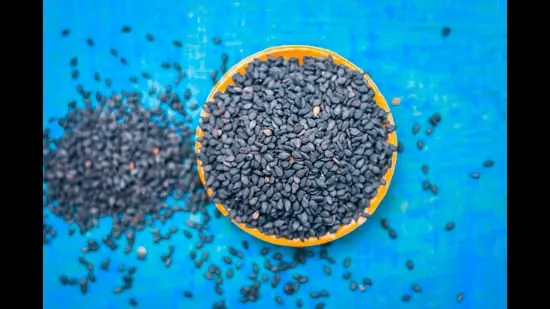
Sesame has a strong and sacred connection to Hinduism. Called til or ellu, it is used in havans and for every type of ancestor worship, ranging from tarpanam to shraadham. Ellu is said to have been the sweat of Vishnu’s body and washes away sins. All over India, the humble sesame seed is used for both solemn rituals and festive feasts.
In Bangalore, Sankranti is also the time to buy fresh sesame seeds which go into the making of the signature sweet of this season: the ellu-bella. Think of it as a healthy trail mix. You start with dry roasted coconut slices, then add roasted peanuts and chutney kadalai or roasted Bengal gram, throw in lots of roasted sesame seeds, and finally add spikes of dried jaggery. Make a batch and you can munch on it for months. A vegan naturalist I met in California told me that sesame was a great source of both protein and calcium, something that I have since researched. This tiny seed is a nutritional powerhouse.
As its Latin name, Sesamum indicum indicates, although sesame is thought to have originated in Africa, the cultivated species was domesticated in India some 5000 years ago. When ripe, the sesame seed pods had a tendency to split open suddenly to scatter their seeds, which meant that they had to be harvested before this spontaneous splitting, likely the reason why Ali Baba uttered the incantation, Open Sesame. Thankfully, in the 1950s, non-scattering varieties were developed and now they can be harvested mechanically. So the market is flooded with fresh sesame, and since it keeps for a long time, this is the time to stock up for your annual supply of sesame seed powder, called ellu podi in Uttara Karnataka.
During Sankranti, these sesame seeds become offerings. In the evening, people would visit each other’s homes and distribute containers of ellu-bella. This tradition, called yellu beerudu or “fill with sesame seeds” is accompanied by the saying, “Yellu bella thindu olleya mathaadu,” or “Eat jaggery and sesame seeds and say good things.” I can imagine old grandparents saying this to the next generation while shaking their heads dismissively.
The other sweet that is made during Sankranti called sakkare acchu. This is when sugar syrup was poured into a variety of molds that had the shape of roosters, dolls, shells, or whatever was in fashion. or moulded sugar syrup. It is perhaps more recent than the jaggery preparations because refined white sugar is a later addition to our diets.
The Hindu calendar is punctuated by the harvest, and in a couple of months, we will have Yuga-adhi, or Ugadi. One of my favourite things about Ugadi is the bevu-bella combination. You can taste this in the Ugadi pachadi, a potent mixture of neem flowers, new tamarind, jaggery, tender mango, pepper and salt. These five ingredients represent the five tastes and the five emotions. Together, they signify that you need to accept the bitter with the sweet. This is messaging at its most subtle, something that I as a parent can learn from. When I tell my kids that they should accept the good and bad, they roll their eyes. Instead, I should just give them the Ugadi pachadi or traditional sweets.
All our festivals connect faith and community, but our harvest festivals are special because they connect us to the earth and the cosmos through our calendar. The foods that we prepare during this time are not delicacies – I mean, eating neem as a sweet takes some getting used to. As a parent though, you can call them an edible philosophy that prescribes how to live.
(Shoba Narayan is Bengaluru-based award-winning author. She is also a freelance contributor who writes about art, food, fashion and travel for a number of publications.)