



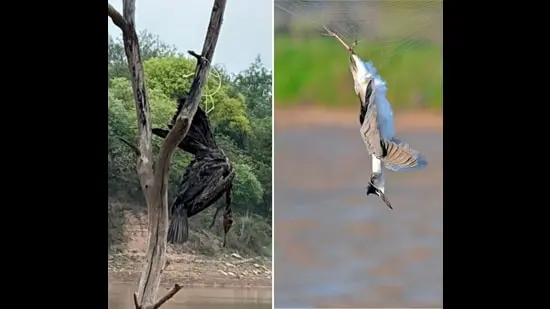
Birds that prey on fish in wetlands and ponds have been left to the mercy (or a complete lack of it) of commercial fish contractors. Though birds enjoy statutory safeguards and their killing is a punishable offence under the Wildlife (Protection) Act, 1972, they are being netted and left to die in agony, often hanging upside down for hours before the mercy of death delivers them from a cold-blooded human agency.
Fact is, the forest and wildlife department does precious little to keep a watch on birds in areas where commercial fisheries have been licensed. Fish-hunting birds flock naturally to water bodies, which were earlier free of commercial fisheries but have since been turned into veritable minefields by vigilant chowkidars of fish contractors. The wetland is overlaid with nets and strings which trap the hapless, unknowing birds flying in for food. Such offences directly attract Section 9 of the Act, which prohibits hunting of protected species.
However, such is the immunity enjoyed by commercial fishermen that they even kill birds and string them like scarecrows over the water to deter forays. This illegal cover stems from the fact that law-enforcement officials seldom stir into the field to keep a watch on ground zero and provide protection to their winged wards — a solemn duty mandated by Parliamentary legislation.
This cosy self-serving ‘system’, which suits fishermen and law-enforcement officials, would have remained hidden from public awareness had it not been for birders and citizen scientists. These non-government entities have at their own expense and risk photo-documented numerous instances of resident and migratory birds “murdered” by fishermen, but no accountability is fastened on them for “war crimes against nature”.
Knight of the lady’s loo
Spiders and their perplexing webs attract more than just ignorance. They are frequently viewed through the prism of superstition, as omens foretelling death, and, of course, as the anathema of orderly house-keeping. A scientific understanding of spiders is of the lowest order of priority in the imposing hierarchy.
Take the huntsman spiders of which an impressive specimen was photographed on the door of the lady’s loo at Antler Woods, a nature retreat at Siswan. This is a large spider, which does not weave webs but hunts cockroaches, moths, crickets, lizards, etc., using speed and agility. It outruns prey, pins it down with a “web of legs”, and injects venom.
So, not only are spiders bio-agents for pest control with respect to agriculture, horticulture and vegetation but they keep our homes and loos free of the invasion of such creepy-crawlies as cockroaches. Nothing is left to the imagination of a washroom scene where cockroaches, unchecked by spider predation, slip between and up the proverbial fair ankles with impunity and a bristly brush, the resultant shrieks heard halfway down the neighbourhood!
Huntsmen are known for being non-aggressive towards humans though they can look dangerous to the uninitiated eye that relies on “mohalla myths” to fuel negative attitudes towards creatures as reviled as serpents, lizards and spiders.
“How apt that you found this character in the washroom; they are apex predators in these human-made microhabitats, often preying on cockroaches. The common name, “huntsman”, applies to the entire Sparassidae family, which comprises nearly 1,400 species of spiders,” Samuel John of ‘Spiders and The Sea’, whose noble aim is to bridge the gap between people and nature, told this writer.