



At a time when global supply disruptions and rising prices are heightening concerns over India’s dependence on imported fossil fuels, scientists are highlighting Dimethyl Ether (DME) as a promising clean-burning alternative to Liquefied Petroleum Gas (LPG).
Developed and scaled by researchers at CSIR–National Chemical Laboratory in Pune, the technology could significantly reduce India’s LPG imports while supporting the country’s push for energy self-reliance.
India currently imports more than 80% of its fossil energy, making it vulnerable to global supply chain disruptions and geopolitical chokepoints. LPG, widely used as a cooking fuel under the Pradhan Mantri Ujjwala Yojana that provides subsidised gas connections to rural households, has recently witnessed price volatility due to international supply constraints. Against this backdrop, researchers say DME could emerge as a sustainable, indigenous substitute.
DME is a synthetic fuel known for its clean combustion characteristics, emitting very low levels of soot, nitrogen oxides (NOx), sulphur oxides (SOx) and particulate matter. Scientists say its thermal efficiency is comparable to conventional fuels, making it suitable for both domestic and industrial applications.
Apart from cooking fuel, DME has several potential uses. It can serve as an automotive fuel, replace ozone-depleting chlorofluorocarbons (CFCs) in aerosol propellants, and act as a chemical intermediate in producing industrial chemicals such as lower olefins, dimethyl sulphate and methyl acetate.
According to researchers, DME can be blended with LPG in significant proportions, helping reduce import dependence. The Bureau of Indian Standards has already issued IS 18698:2024, allowing up to 20% DME blending with LPG for domestic, commercial and industrial use.
Experts note that replacing up to 8% of LPG with DME requires no modification to existing infrastructure, including cylinders, regulators, hoses, gaskets and burners.
“DME burns cleaner than conventional fuels, emitting minimal amounts of soot, nitrogen oxides (NOx), sulphur oxides (SOx) and particulate matter. It also offers thermal efficiency comparable to traditional fuels, making it suitable for household and industrial applications,” CSIR-NCL said in a statement.
India imported around 21 million tonnes of LPG in 2024. Researchers estimate that substituting 8% of LPG with DME could save nearly ₹9,500 crore annually in foreign exchange. For the 10.5 crore households covered under the Ujjwala scheme, achieving an 8% blending target would require DME production of about 1,300 tonnes per day.
Scientists say domestic production of DME from methanol could offer the fastest route to reducing LPG imports, as methanol supply chains are relatively more diversified and resilient than LPG. In the future, India could also produce methanol—and subsequently DME—from coal reserves and dry biomass through gasification processes.
Researchers also highlight the possibility of producing DME from captured carbon dioxide, which could help address climate change.
“India imported around 21 million tonnes of LPG in 2024. Scientists estimate that substituting 8 per cent of LPG consumption with DME could lead to annual foreign exchange savings of about ₹9,500 crore. Replacing 8 per cent LPG with DME for roughly 10.5 crore LPG connections under Ujjwala scheme would require a production capacity of about 1,300 tonnes of DME per day,” the release informed.
Scientists at CSIR-NCL have developed a patented process technology for DME production using an indigenously designed catalyst that enables efficient conversion of methanol to DME. The work was led by Thirumalaiswamy Raja, chief scientist at the Catalysis Division.
“We are now preparing to scale up the technology to a demonstration plant with a capacity of 2.5 tonnes per day, which we expect to be operational within six to nine months in collaboration with a process engineering partner. A successful demonstration will pave the way for commercial plants with capacities of 50 to 100 tonnes per day. We are also exploring partnerships with major oil PSUs and bioenergy companies for commercialisation,” said Raja.
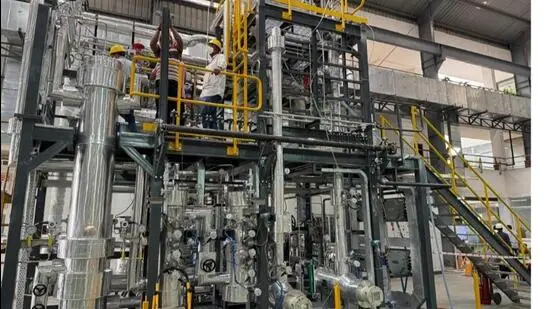
The technology integrates advanced catalyst chemistry with reactor engineering, enabling DME production at 10-bar pressure, which allows the fuel to be directly filled into LPG cylinders with minimal operational cost impact. The process has already been successfully demonstrated at a pilot plant with a capacity of 250 kg per day.
In addition, CSIR-NCL has developed a patented flex-fuel burner capable of operating on 100% LPG, 100% DME, or any blend in between. The burner’s efficiency has been tested at the LPG Equipment Research Centre in Bengaluru.
Researchers say widespread adoption of DME could play a crucial role in reducing fossil fuel imports, strengthening energy security and lowering emissions. With potential applications spanning cooking fuel, transportation, chemical manufacturing and power generation, DME is increasingly being viewed as a key component in India’s transition to a cleaner and more self-reliant energy future.