



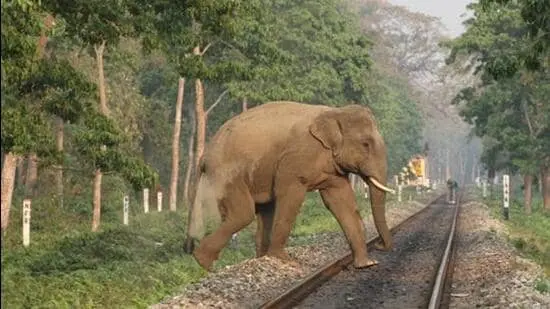
The Wildlife Trust of India (WTI) has honoured the Chakradharpur division of the South Eastern Railway (SER) for its proactive action in stopping a dozen trains to ensure the safe passage of an elephant herd on October 31 and November 1 last year, officials said on Thursday.
“On October 31 and November 1, 12 long-distance trains were temporarily halted between Bisra and Bondamunda Cabin ‘A’ in a prompt and proactive decision, which prevented potential wildlife casualties and demonstrated Indian Railways’ strong commitment to human–wildlife coexistence,” Aditya Kumar Choudhary, Chakradharpur senior divisional commercial manager (Sr DCM), told HT on Thursday.
WTI officials honoured nine railway officials, including senior divisional operations manager (Sr DOM) Avinash, in the presence of Chakradharpur divisional railway manager (DRM) Tarun Huria at the DRM office in Chakradharpur on Wednesday evening.
The Chakradharpur division is located on the Howrah–Mumbai main line, one of the busiest railway routes in the country. Elephant movement is frequently observed across various sections of the division, as it lies along forest areas of Jharkhand and Odisha with several elephant corridors.
Meanwhile, the division has once again cancelled 18 local trains from December 25 to 28 in the Rourkela–Chakradharpur section, following information from the forest department about elephant herd movements alongside the railway tracks.
This is the third time the Chakradharpur division has cancelled trains for the safe movement of elephants over the past 10 days.
The division cancelled eight trains from December 22 to 24 due to elephant movements, close on the heels of the shocking disaster in which eight elephants died after being hit by the speeding Rajdhani Express in Assam on December 20.
Nine more local MEMU trains were cancelled by the division on December 17 and 18 in view of frequent elephant movements in the Jharsuguda–Rourkela, Rourkela–Manoharpur–Chakradharpur, and Rourkela–Nuagaon sections. Four more trains were cancelled between the Chakradharpur–Rourkela and Tata–Gua sections on December 20 and 21.
“Due to frequent elephant movements, trains running at night get stalled and lined up, resulting in heavy congestion on the lines and leading to long-distance trains being delayed for hours during the daytime. To avoid this daytime congestion, most of the local trains running at night are being cancelled. The situation is being monitored constantly in close coordination with the forest departments of both states,” said Choudhary.
“The speed of long-distance trains on the Mumbai–Howrah main line is also being regulated and restricted to a moderate speed of 20–30 kmph in elephant corridor regions under the division. Loco pilots have been instructed to follow standard operating procedures (SOPs) and move with proper route clearance by dedicated teams,” he added.