



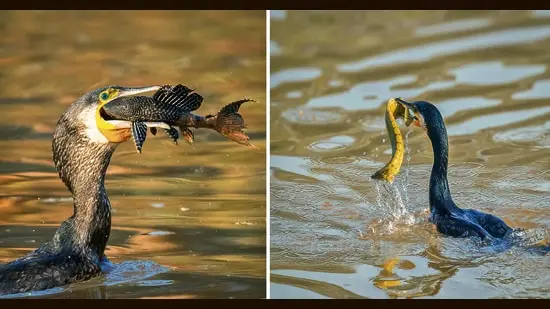
Awaiting clearance from the UT administration to directly net fish samples from the Sukhna Lake for a sanctioned research project, the Panjab University’s Department of Zoology was relying on photographs sent by human anglers and even examining fish bones to second-hand ascertain the diverse species dwelling in its mysterious ripples. And, then, in came migratory great/ large cormorants this winter and one of these formidable avian anglers fished out another new species record for the Sukhna!
Equal credit goes to passionate wildlife photographers who diligently capture cormorant hunting with their expensive equipment. The resultant images in high resolution make identification of the species easier and underline the contribution of citizen scientists to wildlife conservation, biodiversity presence and policy formulation.
In February 2018, award-winning photographer Anuj Jain captured a cormorant with a fish in its bill. Struck by the surreal fish, whose features I had not seen before, I ignored the capable cormorant and had the fish part of the photograph examined by experts.
It turned out to be an Amazonian sailfin catfish of the Pterygoplichthys species, or commonly known as the Sucker fish of aquariums. This is an invasive species released illegally into the lake’s water from the aquarium trade/aquarium owners and poses a threat to native species. Jain’s image of the invasive catfish and the threat it posed was a revelation to not only the Zoology department but to the Forests and Wildlife department.
Recently, Jain again captured an invasive catfish specimen in a cormorant’s bill, his image vividly showcasing the tussle of life and death as reflected in two pairs of contrasting eyes. But the cormorants were not done with their contributions to human knowledge! Dr Manjit Singh emailed me recently an image of a cormorant hunting at the drying, silted pond fronting the regulator spillway gates. A dangling, yellowish eel from the cormorant’s bill intrigued me no end, and I again ignored the principal actor in the image, the bird. I had not seen such an eel from the lake.
I sent Singh’s image to Dr Onkar S Brraich, who is a fish expert and heads the Department of Zoology and Environmental Sciences, Punjabi University, Patiala. Brraich identified the eel as the Barred Spiny eel (Macrognathus pancalus). “It is not a very common species but I have recorded it earlier in some wetlands of Punjab,” Brraich told this writer.
To my elation, and pertinent to Chandigarh’s biodiversity, this eel does not figure in the two Zoology department checklists of Sukhna fish species compiled after netting in 2005-’06 (32 species) and between June 2012 and December 2014 (19 species). It had evaded researchers at Sukhna all this time but was flashed before the world by a cormorant and captured for posterity by an eagle-eyed photographer!
Assistant Professor of Zoology, Dr Ravneet Kaur, who is the principal investigator for the project currently awaiting sanction (titled, Evaluation of Fish Biodiversity in Sukhna lake, 2025-2027), told this writer: “I am thrilled at this valuable input from the cormorant and the photographer! I will include this photographic record of the eel in our Sukhna data. We have proposed three rounds of netting at the Sukhna under our pending project to update species checklist. The eel photograph will be included in our final project report, if we do not bag live specimens of the eel during netting.”