



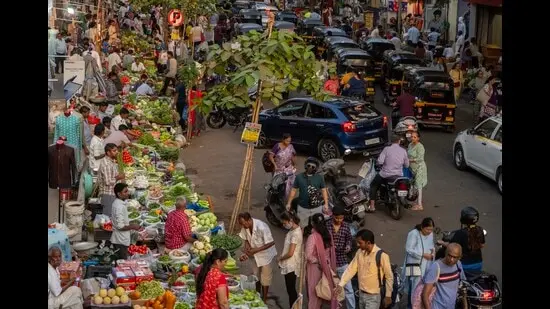
MUMBAI: As Mumbai prepares to place the election results of hawker representatives before the Bombay High Court on Monday to constitute the crucial Town Vending Committee (TVC) after a delay of nearly nine years, Nagpur has emerged as a pioneer in implementing the Street Vendors Act in Maharashtra.
A recent HC order noted that Nagpur leads the state in implementing the Street Vendors (Protection of Livelihood and Regulation of Street Vending) Act, 2014, having successfully set up TVCs and progressed with the statutory framework, even as Mumbai and several other cities continue to grapple with delays.
With 280 TVCs already notified across Maharashtra and Nagpur setting an example, the court made it clear that Mumbai must now move swiftly to complete the process and ensure the act is implemented in letter and spirit.
The election results will confirm that 40% of the Town Vending Committee comprises elected hawker representatives, with details set to be submitted before the court and made public on Monday.
Advocate Jamshed Mistry, amicus curiae appointed by the HC in the hawker matter, pointed out that there had been a complete stalemate in electing the 40% hawker representatives, which led to delays in the formation of the central TVC.
Mistry explained that the central TVC consists of 20 members, including the civic chief as chairperson, with 12 members nominated.
“Only eight members are elected to ensure 40% representation of hawkers, while the remaining members, including representatives from NGOs, civil society, commerce and banks, are directly nominated by the state government,” Mistry told HT.
Emphasising the next steps once the TVC is constituted, the court laid down a clear roadmap outlining its role, responsibilities and functioning, providing much-needed direction for effective implementation of the Street Vendors Act, 2014.
The duly formed TVC will be required to undertake statutory functions beginning with a comprehensive survey of street vendors, followed by the preparation and implementation of a vending scheme. The court clarified that the TVC has the authority to conduct fresh surveys if required and must ensure surveys are conducted at least once every five years. This will allow the inclusion of eligible hawkers, including those who began vending after May 1, 2014, ensuring fairness and transparency.
In addition, the court issued strict directions to the civic body. The BMC must allow 99,435 eligible hawkers to operate strictly as per guidelines and verify the remaining 29,008 applicants within four months. No other hawkers will be permitted to operate unless found eligible.
The civic body has also been directed to conduct a comprehensive inspection of all temporary and permanent stalls on roads and footpaths, verify the identity of all vendors and assistants, and take action against illegal immigrants, including repatriation if necessary. Failure to act will attract personal liability for concerned officers.
The court highlighted that once the TVC is constituted, it must focus on governance, conducting surveys, regulating vending zones, implementing schemes, and balancing the rights of vendors with public convenience.
It expressed concern that despite prolonged litigation and administrative efforts, neither a duly constituted TVC nor a comprehensive vending scheme has been fully implemented. While street vendors and elected representatives continue to seek positions in the TVC, the statutory framework meant to regulate and protect vending activities remains incomplete, causing hardship to both vendors and citizens.
According to the court, the absence of a fully functional TVC has resulted in a dual crisis. “Street vendors continue to face uncertainty and lack of protection under the law, while citizens struggle with unchecked hawking activities that obstruct roads and footpaths,” the order stated.
The situation became so serious that the court initiated suo motu proceedings in 2022 after receiving widespread complaints about encroachments and disorder in public spaces.
The court noted that the process of constituting TVCs has been entangled in money, power and politics rather than governance. Continuous litigation at every stage has delayed implementation of the Street Vendors Act, 2014, for over 12 years, leading to a waste of time, public resources and administrative effort.
It stressed that the primary objective of the Act is to regulate and protect hawkers as a class, not to determine who will occupy positions in the first TVC, and that the prolonged administrative vacuum cannot be allowed to continue.
The court upheld the elections held on August 29, 2024, stating that setting aside the process at this stage would delay the constitution of the TVC by another three years and further stall implementation of the Act. Instead, it directed that the election results be declared immediately and the statutory framework be followed in its true spirit.