



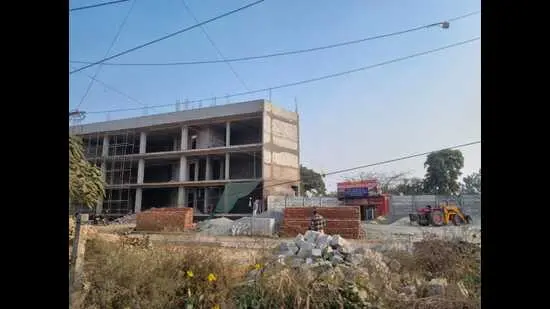
Dust from uncovered construction debris and silica stored along busy city roads and service lanes continues to choke several parts of Gurugram, despite restrictions under stage 4 of the Graded Response Action Plan, an HT spot check on Tuesday found.
The findings came on a day when the Commission for Air Quality Management announced the revocation of Grap-4 restrictions across Delhi NCR following a marginal improvement in air quality. Delhi’s Air Quality Index was recorded at 378 on Tuesday, remaining in the “very poor” category, compared with 410 on Monday and 440 on Sunday. The stricter curbs under Grap-4 were imposed on Saturday, January 17, after air quality slipped into the “severe” category.
The spot check revealed at least three commercial and multiple residential projects operating alongside makeshift supplier shops that had kept bricks, sand and cement uncovered along busy stretches in Sectors 67, 46 and 72. These activities were contributing to high dust levels on roads used daily by commuters and residents.
Under Grap 3, the restrictions target dust-generating activities rather than the mere sale of construction material, a distinction often exploited on the ground. Open storage of sand, stone dust, cement, bricks or soil is prohibited, as is sale, loading or unloading that causes fugitive dust. Makeshift roadside supplier shops on unpaved land are not permitted. In theory, sale is allowed only from authorised premises with covered material, covered transport and adequate dust suppression.
On the service lane of Arya Samaj Marg, excavation work was underway at two sites inside a gated colony, with heaps of sand spread across a 200-metre stretch. Workers were seen drilling and breaking concrete even as Grap-4 remained in force. Digging and excavation using earthmovers were also underway at an under-construction commercial project along the same road on Tuesday morning. At another site on the opposite end of Arya Samaj Marg, workers were carrying out tiling work at a five-storey building.
In Sector 66 near Golf Estate Road, a commercial project had earthwork, concrete mixing and batching activities running through most of the day. Supplies to such sites were being fulfilled by small shops operating along service roads. Several makeshift supplier sites were found along Golf Course Extension Road and Prajapati Road, where Yamuna River sand or grey plastering-grade sand was stored loose.
“Every time any vehicle passes, the silica blows into the air, irritating our eyes and throats. It becomes unbearable to stay here for too long, as the air quality remains very poor on the entire stretch,” said a daily commuter, requesting anonymity.
On Maidawas Road, where a private showroom was under construction, a nearby makeshift shop had emerged to supply materials. “To meet our daily needs, we have to provide stone dust for plastering purposes. Things such as good air quality are secondary to us,” said a worker at the shop.
Along NKV Residency roads, several small suppliers were operating from a large plot. “The transportation rates are currently high; however, bricks, sand and cement are supplied routinely in the city. Once pollution levels come down, rates will automatically go slightly low,” said a shopowner, seeking anonymity.
A senior official of the Haryana State Pollution Control Board said inspection teams were conducting routine checks and that most commercial sites had temporarily shut operations. “Those who are still flouting the norms will be penalised through a hefty environmental compensation,” the official said.
Among the roads found with unpaved surfaces and dust-laden edges on Saturday were Golf Course Extension Road, Maidawas Road, Hero Honda Chowk, Bhaktawar Chowk, Netaji Subhash Marg, East Ramgarh Road, Dayma Road and Main Gujjar Road, among others.