



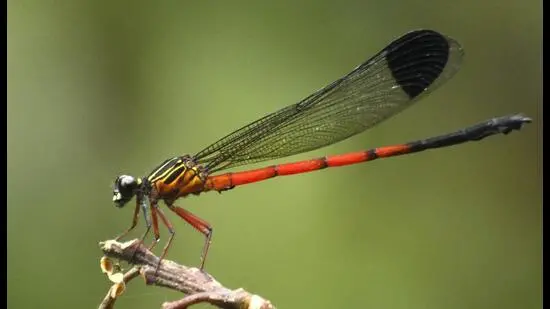
PUNE: A comprehensive new study of dragonflies and damselflies across the western ghats has revealed a yawning gap in biodiversity records, with researchers documenting only about 65% of historically known species. The nearly 35% gap is being seen as a warning sign of mounting ecological stress in one of the world’s richest biodiversity hotspots.
The study – among the most extensive, recent assessments of freshwater biodiversity in the western ghats – was carried out over two years from February 2021 to March 2023 by researchers from MIT World Peace University (MIT-WPU), Pune, in collaboration with the Society for Odonate Studies. It was recently published on April 21, 2026 in Biology Bulletin Reviews.
The research covered 144 sites across five states—Gujarat, Maharashtra, Goa, Karnataka and Kerala –and focused on ‘Odonata’, an order of insects comprising dragonflies and damselflies. These species are widely recognised as sensitive bioindicators, meaning that their presence or absence reflects the health of freshwater ecosystems such as rivers, streams, ponds, lakes and wetlands.
The research team – led by Pankaj Koparde; along with Arajush Payra, Amey Deshpande and Reji Chandran – undertook extensive field surveys across diverse and often remote habitats. Despite logistical challenges, including difficult terrain and regulatory permissions, the team recorded 143 distinct odonate species, 40 of which are endemic to the western ghats.
However, the findings revealed a worrying gap. Historically, around 200 odonate species have been recorded in the region through various studies. The current survey documents only 143 species, pointing to a substantial decline or absence of nearly one-third of these ecologically important insects.
Highlighting the implications, Koparde said, “Earlier studies had recorded nearly 200 odonate species in the western ghats. This number has reduced significantly in our recent study. We also observed that species diversity is higher in the southern part of the western ghats and relatively lower in the northern regions. This suggests that habitat loss, possibly driven by developmental projects, could be a major factor contributing to this decline.”
Odonates depend entirely on freshwater ecosystems for breeding and survival, making them particularly vulnerable to environmental disturbances. Their reduced presence is often an early indicator of ecological degradation, including declining water quality and habitat fragmentation. This study identifies multiple, overlapping threats across the western ghats including linear infrastructure development such as highways and railways, hydropower projects, pollution, and large-scale changes in land use, not to mention unregulated tourism, forest fires, and the intensifying impact of climate change.
A state-wise analysis of the data reveals significant regional variations. Maharashtra – where the highest number of sites (105) were surveyed – recorded 100 species, including 12 endemic ones. Kerala – where only 14 sites were surveyed – recorded 83 species, 33 out of which are endemic. Karnataka (17 sites) documented 64 species, including six endemics; Goa (three sites) recorded 35 species, including four endemics; while Gujarat (five sites) recorded just 18 species with no endemics.
Furthermore, three species — Elattoneura souteri, Protosticta sanguinostigma and Cyclogomphus ypsilon — are currently classified as ‘vulnerable’ on the IUCN red list whereas a large proportion of the observed species falls under ‘data deficient’ or ‘not evaluated’ categories, highlighting gaps in scientific knowledge and the need for further research. Overall, the findings underscore the need for targeted conservation efforts and sustained ecological monitoring. By establishing a baseline across 144 sites, the study provides a crucial reference point for future biodiversity assessments and policy interventions.