



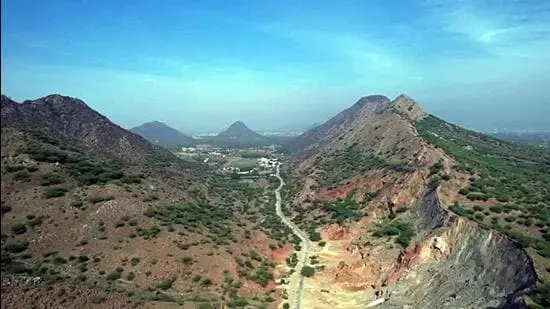
The public outrage and media meltdown over the Supreme Court’s order regarding the definition of a hill in the Aravalli mountain range may seem unexpected. However, this mountain range, spreading over 700km between Palanpur in Gujarat, Madhya Pradesh, Rajasthan, Haryana and Delhi-NCR, is quite literally the bed rock of the Indian subcontinent. The Aravallis rose more than 1.6 billion years as a result of the Indian plate breaking away from the Eurasian plate. The mountain range joins the Bundelkhand and the Aravalli cratons (undeformed layers of tectonic plates). The Aravalli’s historicity is not just geological in that; besides slowing down the desertification of north-eastern Rajasthan, Haryana and even Delhi, the mountain range has been the source of important rivers such as the Banas, Luni, Sakhi and Sabarmati.
The mountain range is home to some of the most celebrated as well as revered pilgrim spots cutting across religions. On Guru Shikhar, the highest peak (1722 mts), Dattatreya, an avatar of Vishnu, is said to have lived in a cave. Not too far from here is Mount Abu, a wide plateau which is home to intricately carved Jain temples of Dilwara that were built by Vimal Shah, the Jain minister of Bhima I, the Chalukya king, in whose reign (1022-1064 CE), the Somnath temple was plundered for its great wealth. The Abu region has been referred to as Arbudaranya or the forest of Arbuda in the later Puranas. Legends relate that sage Vashistha retired to this mountain after his quarrels with Vishvamitra. Perhaps more importantly, Mount Abu is the site from where the third lineage of Kshatriya-Rajputs claim origin. The fire-born Agnikula clans, i.e., the Paramaras, Chauhanas, Pratiharas, and Solankis (Chalukyas) claim that Vashishtha made a sacred grove at Abu to recover the his Kamdhenu (wish fulfilling cow) which had been stolen by Vishvamitra. To execute this, Vashistha produced a warrior who became the progenitor of all Agnivamshis. The reference to this story is first found in the medieval text Navasahasankacharita which was composed in the reign of Paramara king Sindhuraja (997-1010 CE).
Ancient copper mine
Haryana is often described as the cradle of Hindu culture. Puranic and religious importance aside, the Aravalli range is also one of the oldest known sources of copper in the subcontinent. The Tosham hills complex, 150km north-west of Delhi in the Bhiwani district of Haryana, contains copper mines that scientists have speculated to have also been the source for the Indus Valley Civilisation. However, more concrete evidence of this igneous rock outcrop comes through a 4th or 5th century inscription that tells us about the construction of a monastery and water tank for preceptors belonging to the Satvata lineage during the rule of an early Yadava king. The sulphur springs present here are likely to have been the source of its sacrality. The inscription says, “Translation: “Verily victory has been achieved again and again by Vishnu– a mighty bee on the water lily that is the face of Jambavati – a very frost to the beauty of the water lilies which are the faces of the women of the demons! This reservoir and the residence above, and a second reservoir, intended for the use of the feet of the Lord, (are the work) of the acharya Somtatra, the great grandson of Yashatatra – a successor of many men (of preceding generations), an Arya Satavata, yogacharya and devotee of the Lord….”
Mangar Bani: India’s oldest paleolithic site
The evidence of Aravalli’s intimate and almost eternal bond with Indian history lies no further than a short drive from India’s capital, New Delhi. At Mangar Bani, a sacred grove lying between the rapidly urbanising cities of Delhi, Gurgaon and Faridabad, locals have been worshipping at the shrine of Gudariya baba, a local seer, for many generations. They believe that protecting this grove is essential to keeping Gudariya baba’s wrath at bay. This belief has meant that even though the surrounding areas have been mined and taken over by real estate mafia, Mangar Bani has remained relatively safe. Perhaps what forms the basis of this belief is that besides the Arvalli range acting as a sponge and replenishing Delhi’s groundwater every monsoon, there is an abundance of paleolithic rock art and cave paintings in and around Mangar Bani. According to the Haryana Archaeology department which conducted multiple surveys of the site between 2017 and 2021, the painting and art could predate Bhim Betka, the most celebrated rock shelter and art site dating back to more than 20,000 years before present. In fact, although 28 such prehistoric sites had been identified in the Aravalli hills of Haryana and Delhi-NCR a few decades ago the latest official recognition of cave paintings and rock art have led archaeologists to push back human presence to as much as 100,000 years ago. Erasing the Aravallis would mean risking losing our collective heritage forever.
(HistoriCity is a column by author Valay Singh that narrates the story of a city that is in the news, by going back to its documented history, mythology and archaeological digs. The views expressed are personal.)