



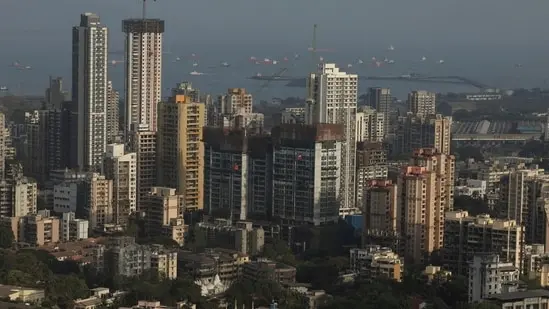
In 2025, residential sales in India’s top eight cities reached 3.48 lakh units, down 1% YoY. Sales momentum remained steady despite rising prices, with NCR leading at a 19% YoY price increase, followed by Hyderabad (13%), Bengaluru (12%), and Mumbai and Chennai (7%), according to a Knight Frank report released on January 7.
Real estate consultant Knight Frank India noted that the decline in interest rates on home loans, strong economic growth and lower inflation were some of the key factors that helped in sustaining the housing demand during the 2025 calendar year despite fears of an impending correction.
Knight Frank India in its flagship report, India Real Estate: Office and Residential Market – July to December 2025 (H2 2025), noted that sale of residential properties in the Mumbai region rose 1% to 97,188 units. The average housing price rose 7% in the country's financial capital to ₹8,856 per sq ft. The housing sales in Bengaluru remained flat at 55,373 units while the average price grew 12% to ₹7,388 per sq ft.
Also Read: Bengaluru leads the unsold homes surge with a 23% jump as housing inventory across seven cities rises 4% in 2025
In Pune, the sales dipped 3% to 50,881 units, but prices appreciated 5% to ₹5,016 per sq ft. Delhi-NCR saw a 9% fall in sales last year to 52,452 units largely due to the elevated base effect and selective market activity in high-value corridors, while prices appreciated 19% to ₹6,028 per sq ft. Sales in Hyderabad grew 4% to 38,403 units, while prices rose 13% to ₹6,721 per sq ft.
Prices rose across the markets largely due to launch of higher value properties across the markets pushing the weighted average prices. This upward movement was supported by sustained demand, rising construction and land costs, and an increasing concentration of launches in higher ticket-size categories, the report noted.
Market health remained stable, with the quarters-to-sell (QTS) ratio steady at 5.8 in H2 2025, signalling sustained absorption, it noted.
Properties priced above ₹1 crore constitute half of total housing sales
Properties priced above ₹1 crore constituted approximately 50% of total residential sales across the top markets in 2025, registering a 14% year-on-year increase. In absolute terms, 175,091 units were sold in the ₹1 crore-plus category during the year, underscoring the growing dominance of higher-value housing in overall market activity, the report noted.
Also Read: Real estate outlook 2026: 5 most sought-after areas to buy property in the Mumbai Metropolitan Region
In contrast, the sub- ₹50 lakh segment recorded a sharp contraction, with sales declining 17% YoY to 73,694 units, accounting for just 21% of total residential transactions in 2025. This represents a significant structural shift when viewed in a medium-term context; for comparison, homes priced below ₹50 lakh accounted for nearly 63% of total sales as recently as 2022. The mid-range segment ( ₹50 lakh to ₹1 crore) also witnessed moderation, with volumes declining 8% YoY, reflecting increasing polarisation within the demand spectrum.
Shishir Baijal, International Partner, Chairman and Managing Director, Knight Frank India, said, “India’s residential market in 2025 has clearly entered a phase of consolidation at elevated levels. With approximately 3,48,000 homes sold during the year, demand has held steady after an exceptional multi-year run. This reflects genuine end-user depth rather than episodic spikes."
Homes priced below ₹50 lakh continue to face pressure
While housing affordability has improved across most major markets—enabling a sizeable cohort of buyers to move up the value curve—the residential market has simultaneously become more polarised across price categories. Homes priced below ₹1 crore, and particularly those under ₹50 lakh, continued to face pressure through 2025, marked by a concurrent softening of demand and supply. Supply trends in this segment have largely mirrored subdued buyer interest, indicating an absence of speculative overhang.
Gulam Zia, International Partner, Senior Executive Director, Research, Advisory, Infrastructure and Valuation, Knight Frank India, said, “The current trajectory increasingly looks like growth is peaking while city and segment-specific nuances are emerging. Homes priced above ₹1 crore now constitute half of total sales, highlighting the decisive tilt toward higher-value products. Cities such as Chennai and Hyderabad have delivered notable growth, while larger markets like Mumbai and Bengaluru continue to absorb supply steadily despite price appreciation."
At the same time, affordable segments remain subdued as prices continue to grow and demand becomes more selective. Overall, manageable inventory levels and low quarters-to-sell underline a market that is active, disciplined, and structurally sound, he said.
Outlook 2026
Looking ahead, the residential sector stands at a possible inflection where it remains to be seen if the premium segments will continue to support market volumes in 2026. While rapid volume expansion may remain limited after two years of peak sales, stable absorption, selective price appreciation, and disciplined supply additions are likely to define market activity in 2026.