



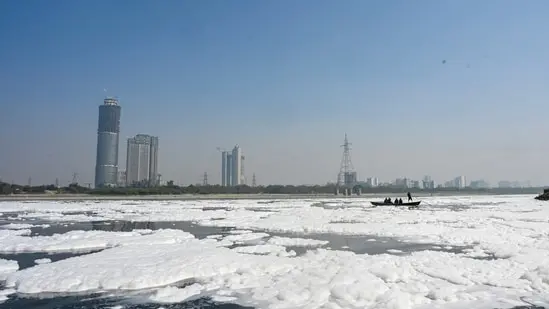
A thick, glacier-like layer of toxic white froth has once again covered stretches of the Yamuna near Kalindi Kunj amid falling temperatures as wind-driven clouds of foam roll across the river surface while devotees pray along its banks.
The phenomenon has intensified during winters despite Delhi Jal Board using a record quantity of defoaming chemicals between October and December, highlighting the continued ecological decline of the river, they added.
Environmentalists said low temperatures help stabilise froth bubbles, but stressed that foaming is only a symptom of deeper pollution. “The attempts of defoaming were only trying to treat the symptoms. Reality is the river water is extremely polluted and ecologically dead at this point,” said Bhim Singh Rawat, a Yamuna activist and member of the South Asia Network on Dams, Rivers and People (SANDRP).
Officials explained that the froth is caused by soap-like surfactant molecules present in polluted water. When water falls from a height at the Okhla barrage, the churning action increases frothing. During winter, lower temperatures make these bubbles more stable, intensifying the visible foam.
Sources of surfactants include detergents from untreated domestic sewage, industrial pollutants, wastewater from dhobi ghats, and organic material released by decomposing water hyacinth trapped near the barrage, Rawat said. The river’s deteriorating condition has once again come into focus around Saraswati Puja, when devotees gather along its banks for idol immersion, he added.
Also Read | Centre to increase Yamuna flow through canals
Separately, a study conducted last year by The Energy and Resources Institute (TERI) flagged poor functioning of sewage treatment plants and common effluent treatment plants in handling toxic sewage and surfactants. The report said surfactants from anthropogenic sources, combined with saponins released by water hyacinth (Eichhornia crassipes), were driving froth formation.
The TERI study identified hotspots at Akshardham, Khichdipur and the Railway Colony dhobi ghats, where white, turbid and untreated wastewater was found flowing directly into the Yamuna through Ganesh Nagar Drain, Shahdara Drain and Drain No. 12A respectively. Rawat said the issue has been repeatedly flagged in multiple studies and even discussed in a parliamentary committee in 20224, but agencies including the Central Pollution Control Board (CPCB), Delhi Pollution Control Committee (DPCC), Haryana Pollution Control Board (HPCB) and National Mission for Clean Ganga (NMCG) have failed to improve river conditions.
According to a response submitted to the Delhi legislative assembly, DJB used 48,000 kgs of defoaming chemicals over 63 days between October and December 2025 near Kalindi Kunj. Froth was not prominent during the Chhath as the deforming drive, higher temperatures and large-scale release of fresh water through Hathinikund barrage had washed down the polluted water.
On December 16, Yamuna activist Pankaj Kumar wrote to Delhi lieutenant governor VK Saxena and the Delhi government, warning that prolonged defoamer use could have long-term ecological impacts. He said constant spraying could reduce oxygen transfer, disrupt microbial activity, and lead to accumulation of non-biodegradable silicone oils and silica particles in river sediments, harming aquatic life.
Meanwhile, Delhi Aam Aadmi Party (AAP) chief Saurabh Bhardwaj on Monday shared visuals of the froth while addressing the chief minister. “Look, Rekha ji, You had said that you had cleaned the Yamuna, and innocent people started immersing in the Yamuna. Due to your one lie, Hindu gods and goddesses are facing this misfortune,” he said.
In response, Delhi BJP president Virendra Sachdeva said that the video showing the idol floating is clearly a AI generated video by the AAP.
Despite multiple attempts, the DJB and the Delhi Pollution Control Committee (DPCC) did not respond to queries.