



The most reliable way to understand a housing colony is not from its master plan but from inside a house.
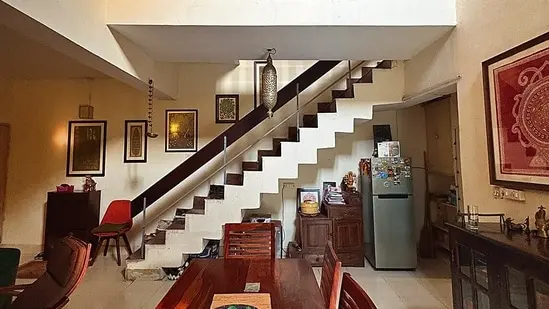
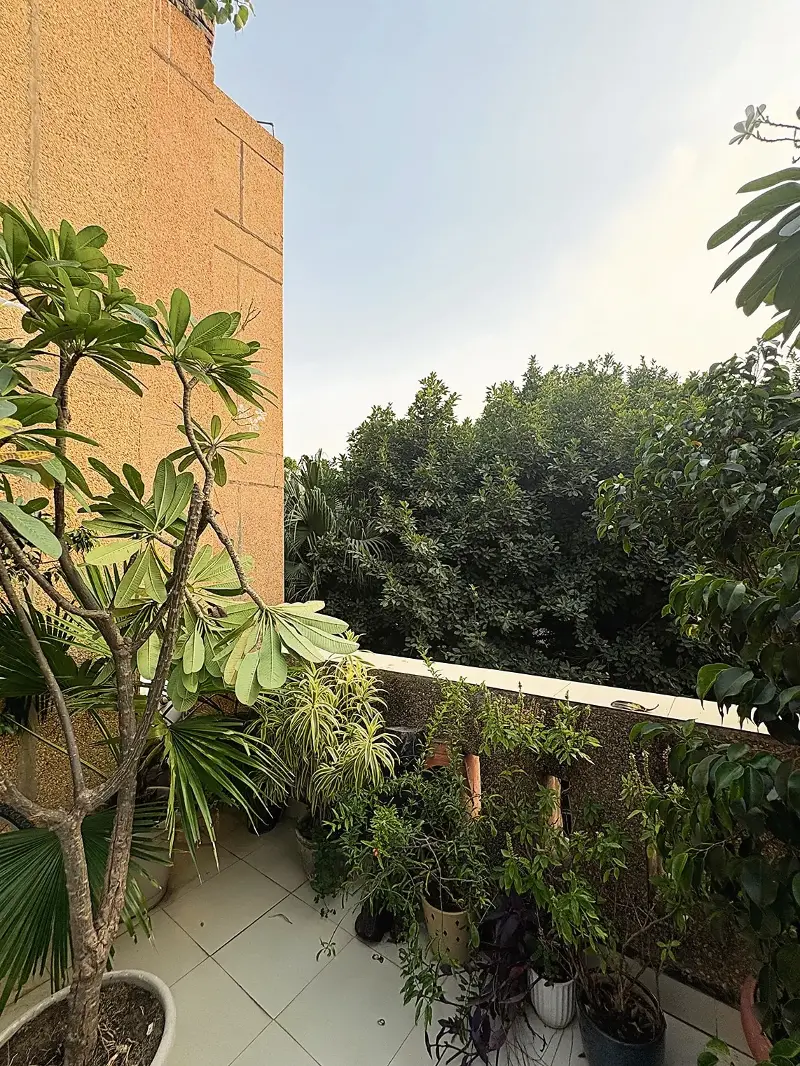
In one duplex at Asiad Village, the dining room rises unexpectedly into a double-height volume. A narrow staircase moves upward along one wall, turning once before reaching the bedrooms. Light enters from high windows. In May, when Delhi heat hardens into something almost metallic, the hot air lifts and escapes upward. The room remains usable without theatrical cooling. The terrace above extends the house into the sky. One begins to understand the project not as outdated design of the 1980s but as a deliberate climatic argument.
Asiad Village was built for the 1982 Asian Games on a 35-acre site beside what is now the Siri Fort Sports Complex. The commission went to Raj Rewal, whose work had already established him as a central figure in post-Independence Indian modernism. His other Delhi projects, including the now-demolished Hall of Nations at Pragati Maidan and the Parliament Library Building, demonstrated an interest in geometry, structure, and civic scale. Asiad Village brought those concerns into the domestic sphere.
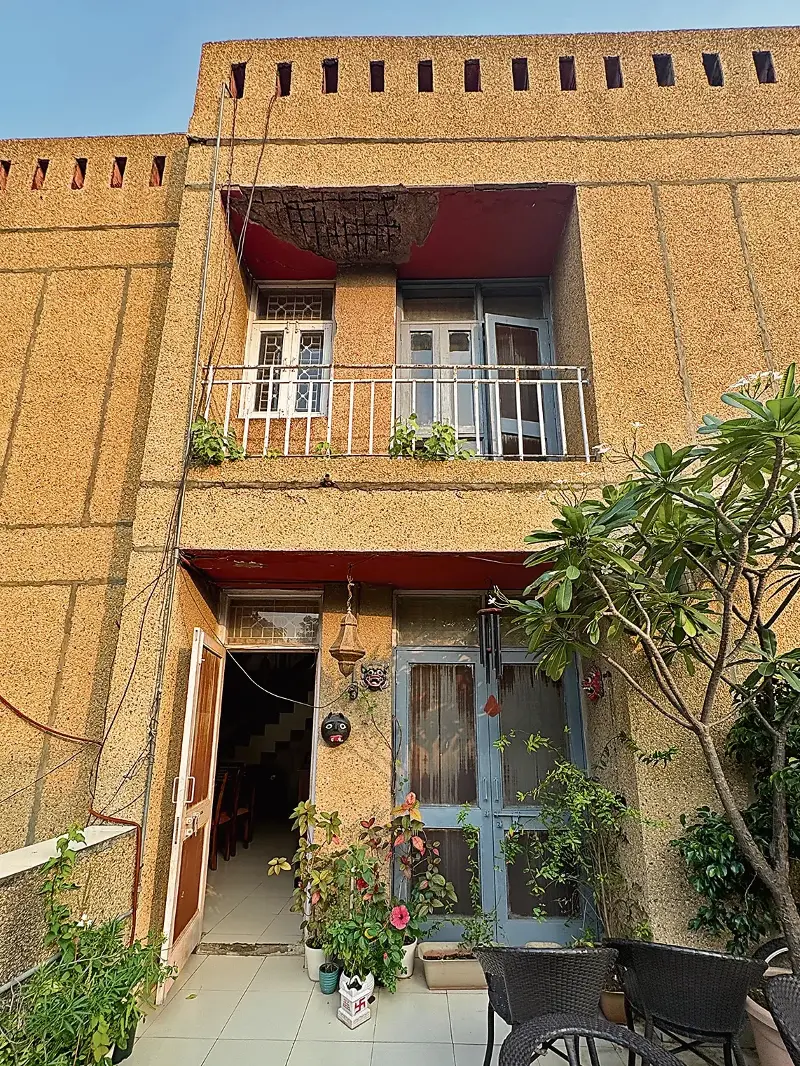
The complex was conceived as low-rise, high-density housing organised into clusters of two to four storeys. Originally around 700 units and now over 850, the apartments were never sold on the open market. After the Games, they were allocated by the Centre to bureaucrats and officials. This fact is important. The colony was not intended as speculative real estate, but as state housing shaped by an architectural vision.
Rewal’s model was the Indian “mohalla”. A mohalla is more than a neighbourhood. The word refers to a tightly knit urban cluster where houses open onto shared lanes or courtyards, where private and semi-public life overlap, and where proximity produces familiarity.
This is what an Indian colony is supposed to be – with implied intergenerational presence and daily negotiation of space. The traditional mohalla of Old Delhi or Jaipur was dense, but rarely anonymous.
At Asiad Village this form is translated into a modern plan. Vehicular movement is planned. Pedestrian pathways connect clusters. Shared greens replace congested alleys. The scale encourages recognition without enforcing intrusion. It is a reinterpretation rather than an imitation.
Climate sensitivity was central to Indian modernism of this period. In the decades after Independence, architects worked without the assumption of universal air conditioning. Delhi’s summers, with temperatures exceeding forty-five degrees, and its heavy monsoons required design intelligence. Thick masonry walls provided thermal mass. Recessed windows reduced glare. Courtyards and vertical voids encouraged cross ventilation. Terraces functioned as usable outdoor rooms during cooler months. In this context, modernism was not about glass curtain walls but about environmental control through form and material.
The exposed brick facades reflect this logic. In 1980s Delhi, brick was locally available, structurally sound and significantly cheaper than cladding systems or plaster finishes. Leaving brick exposed eliminated the cost of plastering and repainting, both of which deteriorate fast in extreme heat and moisture. Brick also ages with a degree of grace. It stains and darkens but does not peel. In economic and climatic terms, it made sense.
Walking through the colony today, the consistency of this material choice is visible. The brick surfaces carry a sense of maturity. Gardens soften the geometry. Internal roads are wide, but not monumental. Compared to later high-rise developments, the environment feels measured.
Yet the reality of occupation complicates the ideal. Government-allocated housing rotates occupants. Each family modifies its unit. Balconies are enclosed. Pipes are replaced. Electrical wiring, rarely designed for decades of increased load, requires upgrading. Seepage marks appear after heavy monsoons. The promise of permanence confronts maintenance budgets.
Even so, the larger spatial order remains intact. Children play in the common greens. Evening walkers trace habitual circuits. The colony maintains a recognisable identity within South Delhi, framed by the mass of the Siri Fort Auditorium and within sight of Ansal Plaza, an early symbol of liberalisation-era consumer ambition.
Rewal once argued that an architect must embody collective values, not merely personal expression. At Asiad Village, that collective value lay in the attempt to build density without alienation, modernity without amnesia. The mohalla was not replicated in ornament but in structure. Community was embedded in the plan.
Four decades on, the colony reveals both the strengths and limits of that ambition. The brick has endured. The plumbing has not always done so. The idea, however, remains legible.
In an era when Delhi’s housing increasingly rises in sealed towers of glass and concrete, Asiad Village stands as evidence of a moment when climate, economy, and community shaped design decisions in equal measure.
It is best understood not from aerial photographs or nostalgic rhetoric but from within a house, where air still moves upward through a double-height void, and a terrace still mediates between interior life and the north Indian sky.