



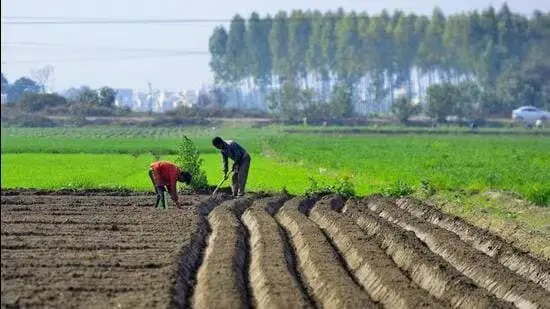
Many Punjabis feel that the state no longer carries the prestige and political influence it enjoyed in the 1980s, when India’s food security depended on it. The loss of clout has little to do with having just 13 MPs. The rise of a government-aided agrarian economy over the years has eroded the leverage once Punjab enjoyed.
For nearly three decades after the Green Revolution, Punjab occupied a position of rare national centrality. Its wheat and paddy fields did more than sustain local prosperity; they underwrote India’s food security. In the 1970s and 1980s, Punjab alone supplied well over half of the wheat procured for the central pool and a substantial share of rice. Along with Haryana, it accounted for nearly three-fourths of national grain procurement at a time when buffer stocks were thin and food scarcity a lived memory.
This indispensability translated directly into political heft. Punjab mattered because the country needed it. Its concerns could not be ignored, its voice carried weight, and its farmers were seen not merely as producers but as partners in a national project. Political influence flowed naturally from economic centrality.
Over the last two decades, this structure changed fundamentally. India’s foodgrain production expanded dramatically, crossing levels unimaginable during the Green Revolution years. Procurement systems matured across a wider geography. States such as Madhya Pradesh emerged as major wheat suppliers, while Chhattisgarh, Telangana, Odisha and Andhra Pradesh became significant contributors to rice procurement. The national food system grew resilient, diversified and surplus-rich.
This transformation did not reflect any failure on Punjab’s part. Its productivity remained high, its farmers efficient, and its procurement systems robust. What changed was the Centre’s dependence. India no longer needed one state to guarantee food security. Punjab’s role shifted from being indispensable to being important—but replaceable. The political consequences of this shift were inevitable, though not immediately recognised.
How political heft was lost
While the Centre’s reliance on Punjab diminished, the state’s reliance on Union government deepened. The minimum support price regime, once a tool of national stabilisation, became the foundation of Punjab’s agrarian economy. Today, almost the entire paddy crop and a large majority of wheat produced in the state are procured by government agencies. Few agrarian regions anywhere are so comprehensively tied to a single buyer.
This arrangement brought income stability but at a cost. Cropping patterns narrowed around wheat and paddy, crowding out diversification. Rice cultivation expanded massively despite ecological unsuitability. Private markets failed to develop at scale, and alternative value chains remained underdeveloped. Over time, Punjab evolved into a government-aided agrarian economy—productive, but structurally dependent on policy continuity rather than market demand.
Dependence & erosion of autonomy
Economic dependence inevitably affects political behaviour. States that rely on markets, exports, industry and services enjoy a degree of autonomy in their engagement with the Centre. Their farmers and enterprises sell to diverse buyers; their economies do not hinge on a single policy instrument. This autonomy translates into confidence and bargaining power.
Punjab’s position is different. When the government is the principal buyer, even a policy hint triggers anxiety. Dependence narrows options. Negotiation becomes defensive. In such a system, farmers cannot exercise leverage through markets; their only instrument is political mobilisation. What appears as frequent agitation is, in reality, a response to vulnerability. It is not belligerence, but fear of losing the sole pillar supporting rural incomes.
Why other states carry more weight today
Punjab’s experience stands in contrast to states like Maharashtra, Gujarat and Tamil Nadu. These states command national attention not because of political alignment or parliamentary arithmetic, but because they host large, diversified and market-driven economies. Their industries, exports, financial sectors and employment bases are deeply integrated into national growth. Policy stability in these states affects investor confidence, revenue flows and macroeconomic performance.
Their farmers and producers do not depend on the government for routine marketing support. Private markets, exports and industrial demand absorb output. This market orientation gives them autonomy—and autonomy generates political influence. In contemporary India, political heft increasingly follows economic scale and independence, not historical contribution alone.
Punjab, by remaining overwhelmingly agrarian and government-sustained, finds itself disadvantaged in this new order.
Punjab’s dependence is compounded by ecological stress. The wheat–paddy cycle has pushed groundwater extraction far beyond sustainable limits, with a majority of blocks now categorised as over-exploited. This environmental debt is not accidental. It is the result of decades of national procurement priorities that rewarded water-intensive crops.
Punjab paid this price in service of national food security. That history matters. The state’s present anxiety is rooted not only in economic narrowing, but in the sense that the costs of feeding the nation were borne locally, while the benefits of diversification are now spread nationally.
Seen through this lens, Punjab’s farm protests acquire a different meaning. They are not demands for privilege, but expressions of uncertainty in a changed political economy. Farmers who once operated from a position of national relevance now feel reduced to petitioners in a system they helped build. Their frustration flows from loss of leverage, not loss of income alone.
This is why appeals to logic often fail. The issue is not merely economic calculation; it is the psychological impact of losing indispensability.
The way forward
Punjab’s path forward lies not in clinging to an eroding model, but in rebuilding autonomy. Diversification into horticulture, dairy, pulses and oilseeds; investment in agro-processing and exports; strengthening private markets; and creating non-farm rural employment are essential steps. These are not merely economic reforms; they are political reforms, because autonomy restores bargaining power.
A more diversified, market-linked Punjab would negotiate with the Centre as a stakeholder, not a dependent. Political heft would follow naturally. Punjab did not lose political clout because it failed. It lost it because India succeeded—by diversifying food production, expanding markets and reducing systemic risk. This transition, while nationally beneficial, has left Punjab struggling to adjust to a new reality.
Recognising this is essential. Punjab’s story is not one of decline, but of displacement within a transformed economy. The challenge now is to help the state rediscover relevance—not through nostalgia for past indispensability, but through economic renewal and restored autonomy. Only then can Punjab regain not just prosperity, but the political confidence that once came from feeding a nation.
( The author is a retired IAS officer. Views expressed are personal)