



Anyone who has travelled from Delhi through Rajasthan on the new Delhi-Mumbai expressway would have noticed the rapid transformation that is sweeping the state. In many ways, Rajasthan is a living illustration of the changes that are taking place in India itself, exemplifying Prime Minister (PM) Narendra Modi’s focus on states as India’s primary growth engines.
These symbols of change exemplify the vision the PM has set out with the focussed goal to turn India into a developed nation — Viksit Bharat — by 2047, harnessing the power of technology. It would not be incorrect to say that we are in the middle of one most transformative periods in our lives in modern India, coming as it does during the high noon of technology and Artificial Intelligence (AI) that are solving problems at a scale, ease and efficiency that were considered unimaginable even a few years ago.
The roadmap for a Viksit Rajasthan @2047 is driven by the coordinates of technology, smartness, data-driven decision-making, and renewable energy. The framework demonstrates the policy matrix to enable the flourishing of the Schumpeterian process of “creative destruction” for relentless improvements in new products and technologies.
One of the core focus areas is to turn Rajasthan into one of the world’s most preferred destinations for AI-optimised manufacturing and industry 4.0 by setting up factories of the future. The coordinating application of AI and industry 4.0 principles, will modernise traditional industries, such as textiles, handicrafts, and marble processing, and also significantly enhance advanced sectors like automotive components, electronics, and pharmaceuticals.
This ambitious vision directly aligns with national manufacturing goals, positioning Rajasthan as a key contributor to the Make in India initiative and a global benchmark in sustainable, digitally empowered smart manufacturing, thereby contributing to a crime-free and citizen-centric economic landscape.
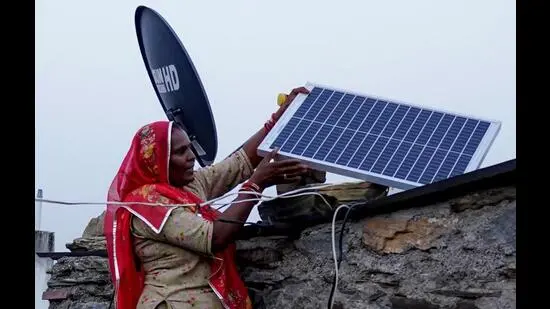
Another core focus area is to turn Rajasthan into the world’s renewable energy capital. This goal is predicated on the unparalleled natural advantages that the state is endowed with. Here are some statistics: 325 sunny days annually, solar radiation ranging from 5.5-6.5 kWh/m²/day, and vast, sparsely populated land resources, particularly in its western regions (covering 342,239 sq km, or 10.4% of India’s total area).
Guided by the far-sighted Viksit Rajasthan @2047 roadmap, the state aims for a detailed, phase-wise expansion of its renewable capacity, targeting 125 GW by 2030, 225 GW by 2040, and 290 GW by 2047.
The economic multiplier effect is projected to contribute significantly to the state’s GDP by 2047, propelling Rajasthan into the top three state economies in India with a projected annual GDP of $4.3 trillion by 2047.
In parallel, the state is targeting several gigawatts of wind energy capacity across multiple districts. Innovative solar-wind hybrid projects will ensure complementary generation, with solar peaking during the day and wind providing power in the evening and night. This will be supported by advanced lithium-ion and flow battery storage systems, offering storage capacity for grid stabilisation and peak shaving.
Additionally, the state is exploring new avenues such as green hydrogen production, which could further transform its energy landscape. For instance, Rajasthan’s Integrated Clean Energy Policy 2024 aims to achieve a target of 2,000 Kilo Tonnes Per Annum (kTPA) Green Hydrogen generation by 2030. The first 500 kTPA Green Hydrogen project will benefit from a 50% waiver on transmission and wheeling charges. Furthermore, 70,000 MW of renewable energy capacity has already been registered to support Green Hydrogen projects in the state.
In the medium-term, the state has set a target of 125 GW of renewable energy and 16.5 GW of storage capacity by 2030, promoting solar, wind, biomass, and green hydrogen projects integrated with battery storage systems to ensure reliable, round-the-clock energy generation.
Another area to spotlight is to solidify Rajasthan’s position as a global hub for innovation and enterprise through Global Capability Centres (GCCs). India is now the world’s GCC capital and these centres have become crucial to global business strategies, driving digital transformation, research and development, and specialised functions.
The government has taken a significant step towards establishing the state as a leading destination for global technology and business services with the approval of the Global Capability Centre (GCC) Policy-2025. The policy aims to attract over 200 GCCs by 2030, generating employment for nearly 1.5 lakh professionals.
Key cities, including Jaipur, Udaipur, and Jodhpur, will be developed as GCC hubs with the necessary infrastructure and support to meet international business standards and accommodate large-scale global operations. To attract companies, the government will provide a range of incentives, including subsidies and financial incentives for GCC operations; infrastructure support, including office space, connectivity, and utilities; and ease of doing business through single-window clearance systems.
The GCC policy is part of Rajasthan’s larger strategy to boost knowledge-driven employment and strengthen its position in the global IT and business services sector. By fostering innovation and collaboration, Rajasthan aims to attract international companies and talent while creating a sustainable economic ecosystem and create a vibrant ecosystem of innovation, collaboration, and expertise, driving critical functions like technology development and customer service. They are equipping themselves to navigate a dynamic landscape.
Progress and development comes when the long-term vision integrates all aspects of governance, economy, society, and environment into a cohesive, technology-enabled future, much like the camel’s firm, nimble and ceaseless strides that withstand and also embrace the changes of time and technology.
Bhajan Lal Sharma is chief minister, Rajasthan. The views expressed are personal