



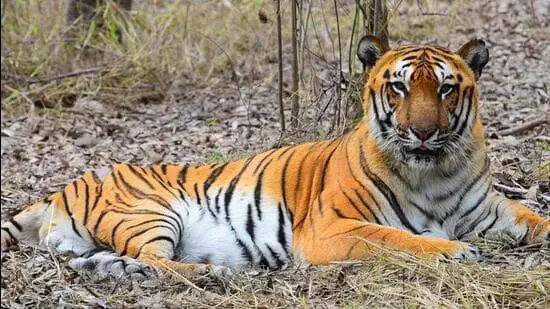
A Supreme Court (SC)-appointed panel has recommended that a tiger reserve be notified in Goa in two stages, citing the need for community consultations, awareness building, and confidence generation, even as the state government opposed the idea. It proposed that the areas contiguous with Karnataka’s Kali Tiger Reserve be first notified as the core area.
The Supreme Court formed the Central Empowered Committee (CEC) after Goa challenged a July 2023 high court order to notify a tiger reserve covering the Mhadei Wildlife Sanctuary and surrounding areas (around 750 square kilometers) in the Western Ghats. It was tasked with examining the issue and filing a report after hearing all the parties.
The committee circulated a copy of its report among petitioners ahead of a hearing in the Supreme Court next month.
The Goa government submitted to the CEC that the area proposed for the reserve has a huge population of around 1,00,000 inhabitants. It argued that they have been living there for over 50 years and would be most unwilling to be relocated.
The government insisted that Goa has no resident tigers and it only has a corridor through which big cats transit from Maharashtra to Karnataka. The petitioner, Goa Foundation, contested these claims.
The CEC has recommended that approximately 468.6 square kilometers of the Cotigao and Netravali Wildlife Sanctuaries, contiguous with the Kali Tiger Reserve, be designated as a core area. It said that the Bhagwan Mahavir Wildlife Sanctuary (64.9 square kilometers) and Bhagwan Mahavir National Park (107 square kilometers) should be notified as a buffer area.
The CEC recommended that protected areas with significantly higher numbers of households be excluded in the first phase. The areas include the southern part of Bhagwan Mahavir Wildlife Sanctuary and Mhadei Wildlife Sanctuary.
“These areas would require extensive community consultations, sustained awareness-building, and confidence-generation measures before any decision regarding their inclusion can be taken. Their incorporation, if found appropriate, may be examined in a second phase, after securing local support and adequately addressing livelihood and rehabilitation concerns,” said the CEC report.
Claude Alvares of the Goa Foundation said that the Goa government’s rejection of a tiger reserve has been rejected.
The CEC recommended that the government initiate the process of notification of the proposed reserve within the next three months. “The State Government shall prepare a Tiger Conservation Plan, as mandated under Section 38V of the Wildlife (Protection) Act, 1972, in consultation with NTCA [National Tiger Conservation Authority], immediately after the declaration of the Goa Tiger Reserve.”
It said the plan shall include measures for strengthening and maintaining habitat connectivity with the Kali Tiger Reserve, regulating, monitoring, and mitigating the impacts of linear infrastructure, mining, and other developmental pressures, improving prey base, etc. “This will ensure that the proposed Goa Tiger Reserve functions as an ecologically integrated and viable landscape, forming an integral part of the larger Kali-Goa conservation complex.”
The CEC cited public apprehension regarding displacement and land acquisition. It said the state government shall undertake structured and sustained awareness programmes to clearly communicate that the declaration of a Tiger Reserve does not entail compulsory relocation of villages from buffer areas nor the automatic acquisition of private land.
“Securing the informed cooperation and confidence of local communities is critical for the long-term success and sustainability of tiger conservation efforts...”
In 2020, the NTCA recommended a tiger sanctuary at the Mhadei Wildlife Sanctuary. The recommendation was made after the deaths of four tigers, a tigress, and three adolescent cubs at Mhadei in 2019. The NTCA had made similar recommendations in 2011 and 2016.