



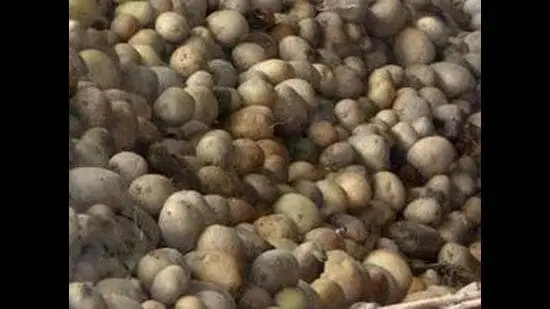
With winter weather turning increasingly cloudy and foggy, potato growers in Punjab have been put on alert as conditions are becoming favourable for the outbreak of late blight disease. Over the past week, temperatures in the state’s major potato belt have hovered between 10 and 22 degrees Celsius, coupled with high night-time relative humidity of over 85 per cent and prolonged leaf wetness due to heavy dew formation. Experts say such weather creates ideal conditions for the rapid spread of late blight, especially in districts like Jalandhar, Hoshiarpur, SBS Nagar, Ropar and Kapurthala.
Late blight is one of the most destructive diseases of potato and can cause severe crop losses if not managed in time. The first signs of the disease appear as small, water-soaked spots on the leaves, which may be circular or irregular in shape. During cool and moist conditions, these spots can expand rapidly into large, dark brown or black lesions that often look greasy. A pale green or yellow border is commonly seen around the affected area. If timely control measures are not taken, the disease can spread quickly and damage the entire crop.
Keeping the rising risk in view, Punjab Agricultural University (PAU) has issued an advisory urging potato farmers to closely monitor their fields. Farmers have been advised to go for preventive sprays even before the appearance of disease symptoms. PAU recommends spraying contact fungicides such as Indofil M-45, Antracol or Kavach at the recommended dose, mixed in adequate quantities of water, at an interval of seven days to protect the crop.
If weather conditions continue to remain favourable for the disease, farmers have been advised to switch to systemic fungicides. These include Curzate M-8, Melody Duo, Ridomil Gold, Sectin 60 WG, Revus 250 SC or Equation Pro, to be sprayed at a gap of about ten days as per the recommended dosage. Experts have strongly cautioned against using under-dosed chemicals or self-prepared tank mixtures, as this can lead to the development of resistant strains of the pathogen, making the disease harder to control in future.